
Biotech finance · Series B shortlist
Finmark alternatives after retirement: rebuild a forecast you can trust
Four replacement paths—and the records to preserve before rebuilding a small biotech’s financial plan.
First-party editorial: we make TrialAgents Runway. Official product sources reviewed on 13 November 2026. These are conditional recommendations, not measured rankings or hands-on competitor tests.
Replace the workflow, preserve the baseline
Choose TrialAgents Runway for an adaptable biotech monthly cash-planning app, Jirav for driver-based financial statements, Fathom for reporting and three-way forecasting, or Excel for a model you control directly. First establish which parts of the old forecast you can reproduce. A polished replacement dashboard will not explain an unexplained opening balance.
BILL acquired Finmark in November 2022. Its indexed Finmark export guide names an April 1, 2026 retirement deadline and lists chart/table exports including PDF, CSV and XLSX. We could retrieve that official search extract, but the full help page returned a loading error. Do not assume accounts or exports remain accessible after the deadline; ask BILL about your account and work from files you already hold.
| Alternative | Good fit | Check before committing |
|---|---|---|
| TrialAgents Runway | Programs, positions, cash-in and spend in a customizable app | Monthly cash planning is sufficient; no integrated three-statement model |
| Jirav | Finance-led drivers, departmental budgets and linked statements | Who will reconstruct drivers and working-capital assumptions? |
| Fathom | Financial reporting plus a three-way forecast | How will your baseline and cash timing be configured? |
| Excel | Direct ownership of bespoke calculations and retained files | Who will maintain formulas, versions and independent checks? |
Runway: give operating assumptions a new home
 TrialAgents
 Runway suits a small biotech whose planning starts with programs, CRO payments, hiring and funding dates. Use supported ChatGPT and Claude connections to work conversationally with authorized records, open the app interface where supported and continue on the web. Embedded UI, conversational operations and automation have separate host and setup requirements; this article is not a new host acceptance test.
Customize the whole app—fields, views, logic and workflows—or build a bespoke app around your review process. Validate financial logic after changes. Add operational apps and configured shared-data connections when programs or agreements should inform the forecast; installing another app does not automatically wire its data into Runway.
Keep review and control explicit. Platform permissions, logs and optional configured automations support the work. Runway’s standard app calculates monthly forecasts and scenarios, with locked budgets, actuals and frozen month-close snapshots. An assistant proposes reviewed inputs; it must not invent or overwrite those outputs.
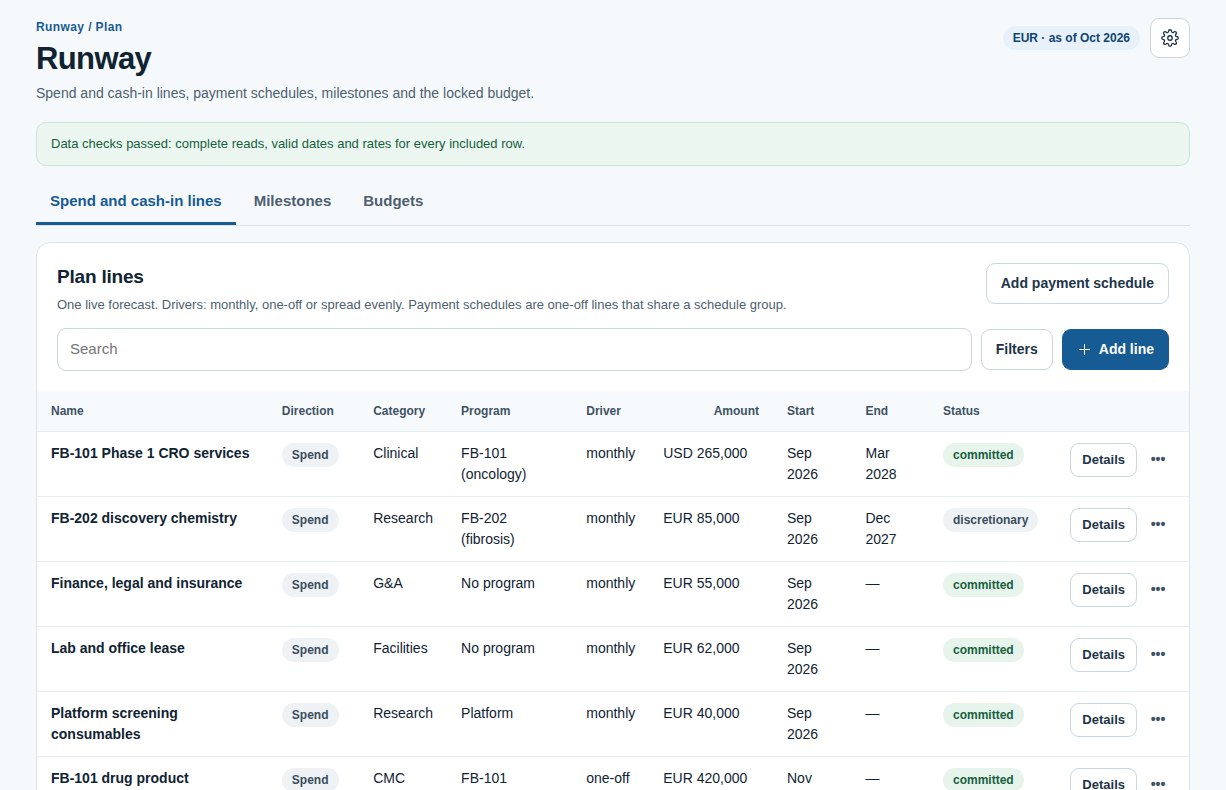
Choose Runway when simplifying the operating plan is the goal. Keep a broader finance system if you need bookkeeping, payroll, bank feeds, integrated financial statements or 13-week liquidity planning. There is no standard Finmark importer or automatic conversion of its formulas. The reviewed spreadsheet-to-Runway mapping guide explains the manual/assistant-assisted approach.
Three other places to rebuild
Jirav: reconstruct the financial drivers

Jirav’s planning documentation describes driver-based budgets, workforce plans, departmental participation and linked income statement, balance sheet and cash flow forecasts. Consider it when finance needs those relationships preserved, rather than a cash-only operating view. Rebuild and review the drivers; an exported total alone cannot establish its original calculation. For the scope distinction, see Runway versus Jirav.
Fathom: rebuild around reporting and a forecast baseline

Fathom’s forecasting guide describes three-way forecasts, external drivers and a baseline-first workflow followed by what-ifs and reporting. Shortlist it when the recurring task is explaining financial results and their outlook. Before choosing, demonstrate your actual cash-timing requirements and confirm your accounting-data connection and mapping; this is not evidence that a Finmark model transfers intact.
Excel: retain direct control, assign a model owner
Excel is a useful reconstruction workspace when you already hold workbooks and need bespoke formulas. However, an XLSX export can contain values without the original model logic. Inspect it before treating it as a working forecast. Keep an untouched copy, name the reviewer and document assumptions. Our Runway versus Excel comparison covers the trade-off between workbook flexibility and a structured operating app.
Reproduce one baseline before improving it
For a pre-revenue biotech, continuity means being able to explain the next hiring decision or CRO payment against the same starting assumptions. Use this reconstruction checklist with any shortlisted tool:
- Freeze the evidence. Retain available exports, board packs, accounting reports and the last approved assumptions. Record their dates, reporting currency, actual/forecast boundary and scenario names. A PDF preserves a view; it does not necessarily preserve formulas.
- Separate cash from accounting. Anchor opening cash to a reviewed month-end balance. Distinguish when a cost is recognized from when it is paid. Separate committed funding from contingent financing; a signed grant award does not by itself establish a receipt month.
- Map each assumption once. Reconstruct current and planned positions, recurring overhead, program commitments and expected receipts. Avoid counting the same staff cost in both a people schedule and an imported expense total. Keep missing assumptions visibly unresolved.
- Explain differences month by month. Compare cash-in, cash-out and closing balances with the retained baseline. Investigate payment timing, currency rates, staffing load and scope differences before approving a replacement. Matching only the final runway date can conceal offsetting errors.
- Approve, then change. Save the accepted baseline and its review notes before exploring a delayed trial or later funding scenario. Where Runway is the destination, use reviewed source records and let the app generate its own budget and close snapshots.
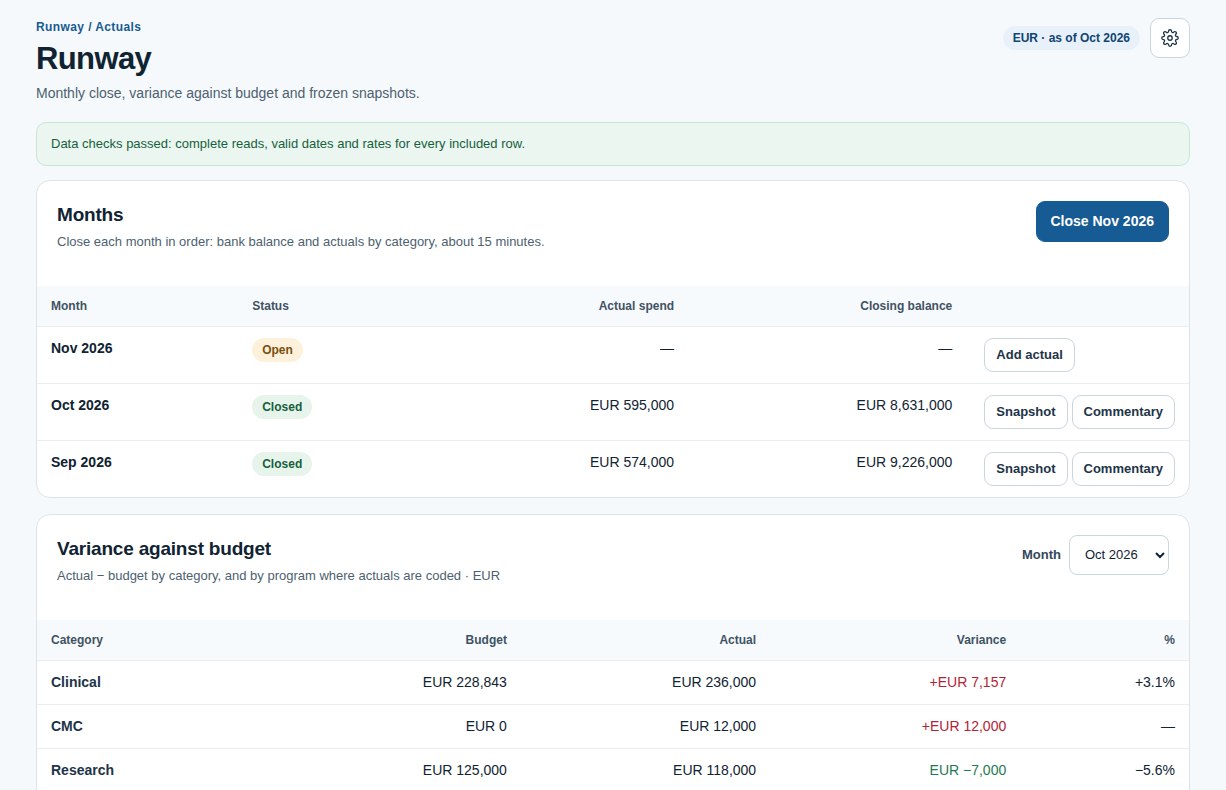
Our recommendation: select the smallest workflow that preserves the decisions your team actually makes. For an adaptable biotech cash app, try Runway with one reviewed baseline. For integrated financial statements, evaluate Jirav or Fathom; for bespoke calculations, keep a well-owned workbook.
Start with Runway
Build a monthly biotech cash plan around your programs, people and reviewed assumptions.
Start with Runway →