
SOFTWARE SHORTLIST
7 Float alternatives for small biotech teams: choose by the workflow you need
Switch for a missing workflow—not simply for another cash chart. Here is where seven alternatives fit, and what to reconcile before retiring your existing forecast.
First-party editorial: we make TrialAgents Runway. Selection is based on current official product documentation and workflow fit, not hands-on competitor testing or measured rankings. Features and connector availability should be confirmed for your account.
First, name what Float is missing for you
For a small biotech, our recommendation is to shortlist by the next decision your forecast must support. Choose Runway for an adaptable monthly operating plan; consider Fathom or Jirav for broader finance workflows; look at LivePlan for a business plan, Aleph for connected spreadsheets, Exigyn for biotech FP&A, or Excel for a bespoke model.
There may be no reason to switch. Float connects to Xero and QuickBooks Online and supports short-term cash forecasting, including a 13-week view. Its QuickBooks integration imports accounting data read-only, with daily and on-demand updates. If your main question is whether a payment clears next week, keep that requirement explicit: a monthly runway chart is not an equivalent replacement.
| Alternative | Shortlist when you need | Check before switching |
|---|---|---|
| TrialAgents Runway | An adaptable biotech operating app | Monthly granularity and reviewed data inputs |
| Fathom | Financial forecasts alongside management reports | Your accounting mapping and reporting package |
| Jirav | Driver-based, linked financial statements | Model configuration and account-level functionality |
| LivePlan | A business plan supported by financial scenarios | How biotech assumptions map into the plan |
| Aleph | Connected Excel or Google Sheets workflows | Connector scope and ownership of model logic |
| Exigyn | Biotech FP&A and clinical accrual workflows | Clinical inputs, integrations and implementation scope |
| Excel | A model you control at cell level | Formula review, updates and version ownership |
TrialAgents Runway: bring the operating plan into the cash discussion
 TrialAgents
 Runway fits a team asking how program timing, hiring and funding assumptions change monthly cash. Start with the approved app, then adapt it around your team’s decisions.
Work through AI and the app. TrialAgents supports authorized ChatGPT and Claude workflows: use the app interface where the host supports it, discuss and operate on permitted records, and continue in the browser. Host capabilities differ; a connection does not guarantee identical embedded interfaces or unattended execution.
Customize the whole workflow. You can request changes to screens, fields, calculations and app behavior, or build a bespoke app. Changes to financial logic need review. Expand with connected apps when program or hiring data should inform finance; shared-data connections must be configured and authorized, rather than assumed.
Keep review controls in the process. Relevant platform access controls, logs and configured automations sit alongside Runway’s monthly actuals, locked budgets and frozen snapshots. The standard app covers monthly spend and cash-in, positions, milestones, forecasts and what-ifs. It is not bookkeeping, a bank feed, an Excel sync service or a linked three-statement model.
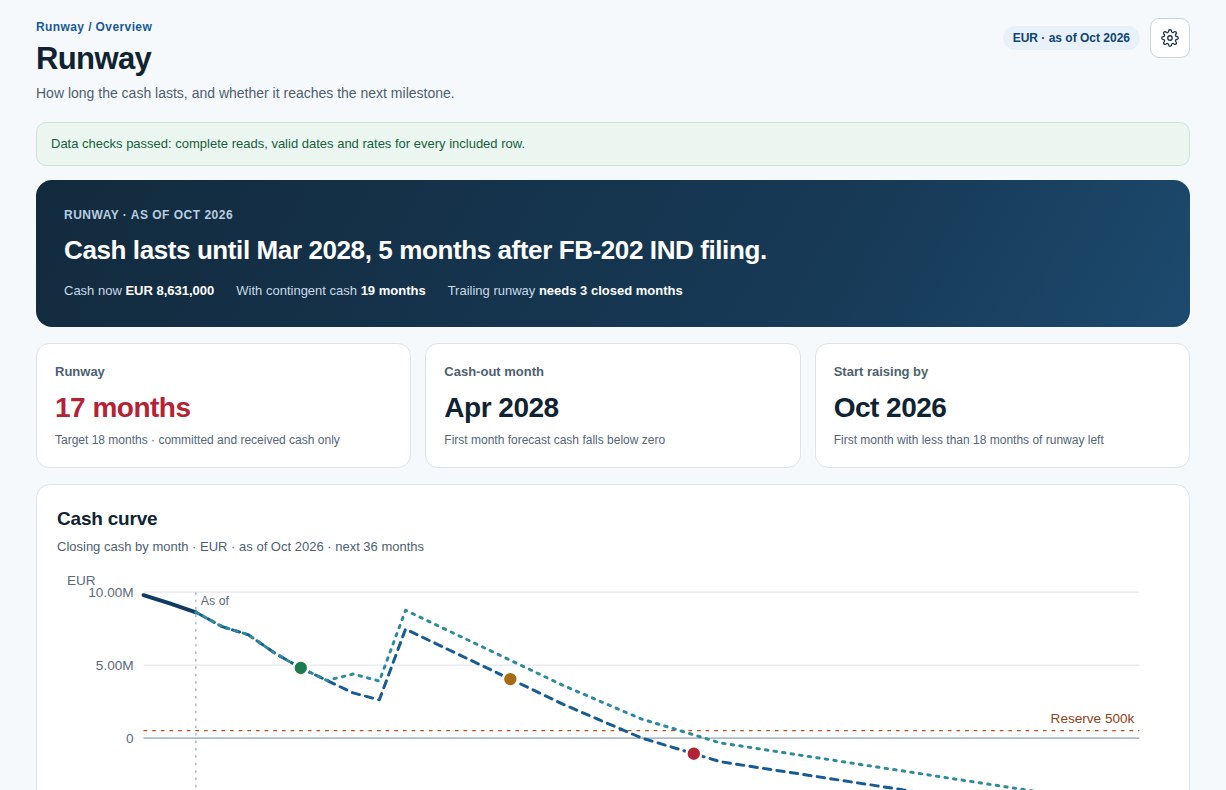
If daily or weekly payment timing remains essential, retain a suitable short-term cash process alongside Runway. See the direct Runway vs Float comparison for the narrower two-product decision.
Six alternatives for a different finance workflow
Fathom — put the forecast beside management reporting

Fathom combines financial analysis and reporting with three-way forecasting and scenarios. Shortlist it when the recurring deliverable is a management pack that connects historical performance and future financial statements. Before moving, test your account mapping and the specific report your board actually reads.
Jirav — build around financial drivers

Jirav offers driver-based planning across the income statement, balance sheet and cash flow, with budgeting and departmental planning. It is a candidate when working-capital and staffing assumptions must flow through a finance model. Confirm the functionality enabled for your account and who will maintain the drivers.
LivePlan — connect the numbers to the business plan
LivePlan brings business-plan writing and linked financial forecasts together; its scenario tools let users explore changed assumptions. Consider it when explaining the business and funding case is the main deliverable. Check how your pre-revenue programs and milestone-dependent funding will be represented.
Aleph — keep the spreadsheet, connect the data
Aleph combines a web FP&A platform with Excel and Google Sheets add-ins, including data pull and push workflows. It suits a finance owner who wants to retain familiar models. Verify each required source connection and refresh behavior; connected data does not remove the need to validate your spreadsheet logic.
Exigyn — evaluate dedicated biotech finance workflows
Exigyn presents biotech FP&A covering runway, clinical accruals, headcount and board reporting, with AI and Claude-connected workflows. Evaluate it when clinical finance depth drives the purchase. Request a demonstration using your accrual inputs and payment assumptions: an accrued expense and a cash payment belong to different questions.
Excel — own the model and its maintenance
Excel remains a practical option when a finance owner needs custom formulas and a bespoke model. Its flexibility also leaves the team responsible for reconciliation, version control and formula review. Use the Runway vs Excel comparison to decide whether that ownership is useful flexibility or recurring work you want to reduce.
Make the replacement prove it can carry your forecast
Our suggested acceptance check is simple: reproduce the current baseline before trusting a new scenario. A successful import, a clean dashboard or an AI-generated explanation alone is not reconciliation.
- Agree the opening cash balance and date. Use the same accounts, currency basis and cutoff in both models.
- Reconcile expected payments. Carry open bills, planned commitments and payment timing without counting the same obligation twice. Keep expenses and cash movements distinct.
- Separate committed and contingent funding. Do not silently turn a hoped-for round or conditional milestone receipt into baseline cash.
- Keep the historical reference. Preserve actuals, the approved baseline and the assumptions used to produce them.
- Run one decision through both models. Move a CRO payment or hiring start and explain every cash difference. Compare monthly totals where appropriate, but separately test weekly liquidity if your process requires it.
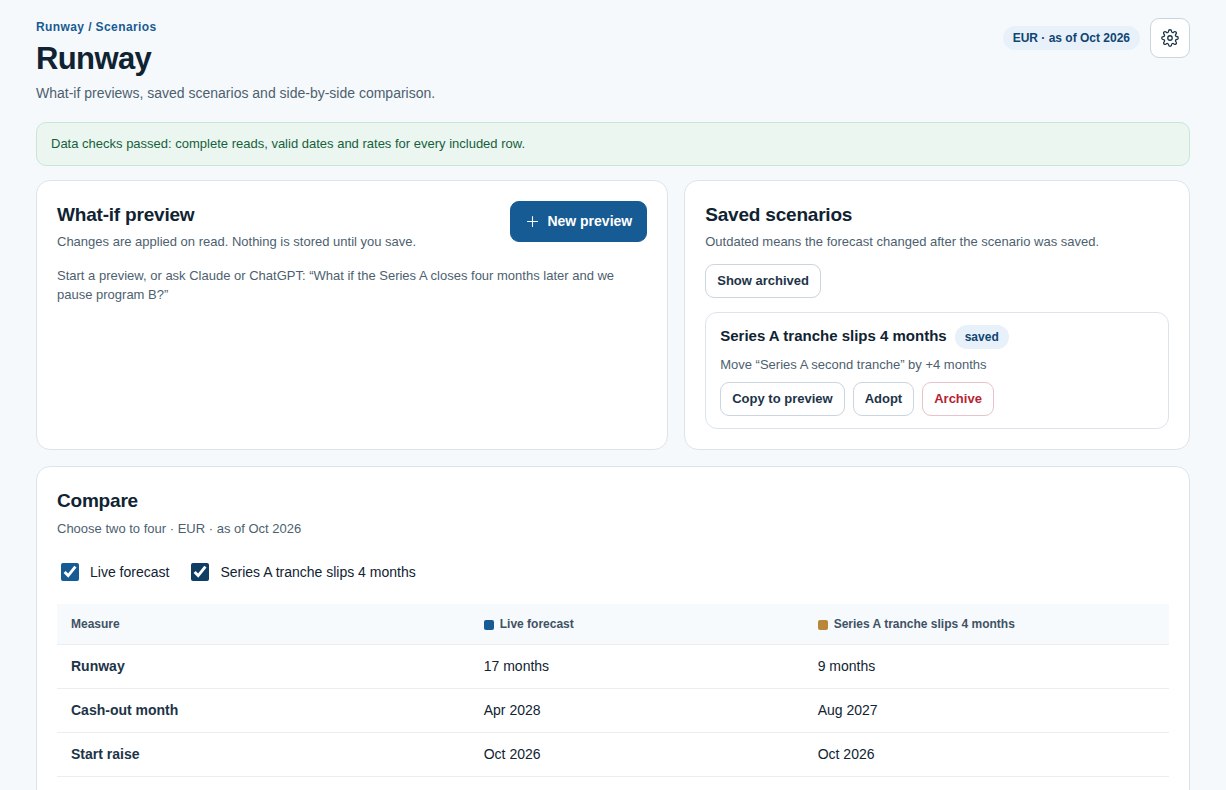
Confirm export and transfer options with each vendor. This guide does not imply a direct Float-to-Runway importer or automatic synchronization. For a broader starting shortlist, see cash runway software for biotech.
Start with Runway
Build your monthly biotech operating plan, review its assumptions and adapt the app around the decisions your team needs to make.
Start with Runway →