
CRO and vendor planning · Series D
Forecast CRO costs and vendor payments: reconcile what is still payable
A €600,000 contract is not automatically €600,000 of future cash outflow. Start with the opening bank balance, subtract payments already made from the contract schedule, and check what sits outside the fee.
First-party TrialAgents guidance. The worked amounts are fictional and independently calculated, not vendor quotes or a completed app or assistant-host test. Images show the genuine Runway browser demo with separate data.
Turn the agreement into remaining payments
Our practical rule is to reconcile contract value, cash already paid and cash still expected before adding a CRO budget to TrialAgents Runway. Preserve the signed agreement and payment evidence as your references; the forecast is not the contract or the accounting ledger.
Timing deserves its own review. In its September 2026 financial statements, ICON describes contractual milestone or unit-based billing schedules that may differ from service delivery, and particular investigator reimbursements that depend on third-party invoicing. That illustrates the distinction; it does not establish the terms of your CRO agreement.
For our fictional biotech, a €600,000 service agreement includes a €120,000 payment already made before the opening balance date. The remaining €480,000 falls due in three instalments: €180,000 in March, €150,000 in June and €150,000 in September 2027. Separately, the team expects €60,000 of reimbursable costs outside that service fee, paid at €10,000 a month from January through June.
Does the quoted fee include investigator and other reimbursable costs? Is a deposit credited against later invoices? Which change orders are approved? Who pays each item? Reconcile the actual documents; never subtract a deposit twice or add a pass-through amount already inside the fee.
Use Plan for cash dates, not a second contract total
In Settings, use €1.5 million at 31 December 2026 as opening bank cash. This balance is after the €120,000 payment. Add €90,000 of monthly company operating spend for January–September 2027, including internal people costs. No separate People entries are needed for those same salaries.
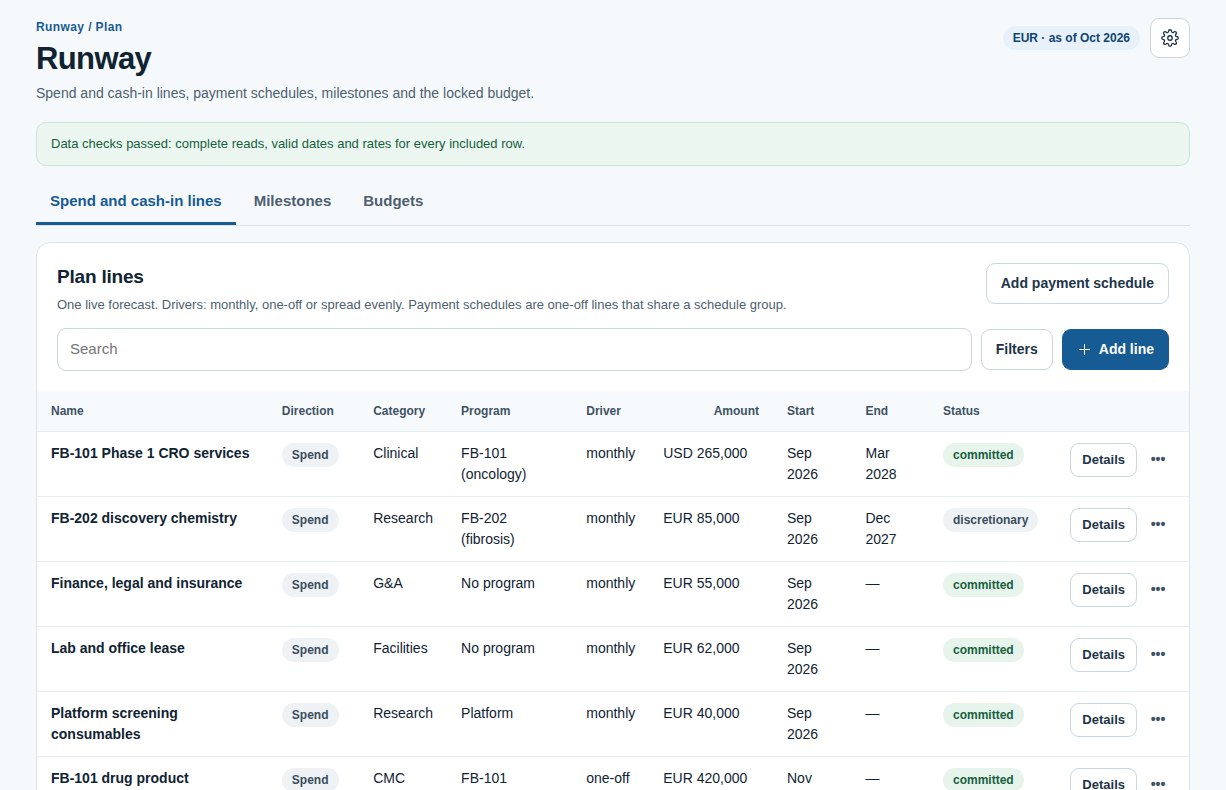
In Plan, enter the three remaining instalments as one-off spend lines. Runway also provides a payment-schedule form that groups one-off lines; use that or individual entries, not both. Associate the correct program, counterparty and agreement where those authorized records are available.
| Item | Amount | Forecast treatment |
|---|---|---|
| Total service agreement | €600,000 | Reference total, not another spend line |
| Already paid by opening date | €120,000 | Already reflected in opening cash |
| Remaining service payments | €480,000 | €180k March; €150k June; €150k September |
| Additional reimbursable costs | €60,000 | €10k monthly, January–June |
| Future vendor cash in this example | €540,000 | Remaining service payments plus additional costs |
Use a monthly driver for the €10,000 rate. A “spread” line instead divides its total over the selected months; it does not turn a contract value into its real invoice schedule. Label estimates clearly in notes and choose status deliberately. The example includes the full €60,000 estimate in its forecast; it is not assumed to be an approved invoice.
Prove that the forecast reconciles to the source
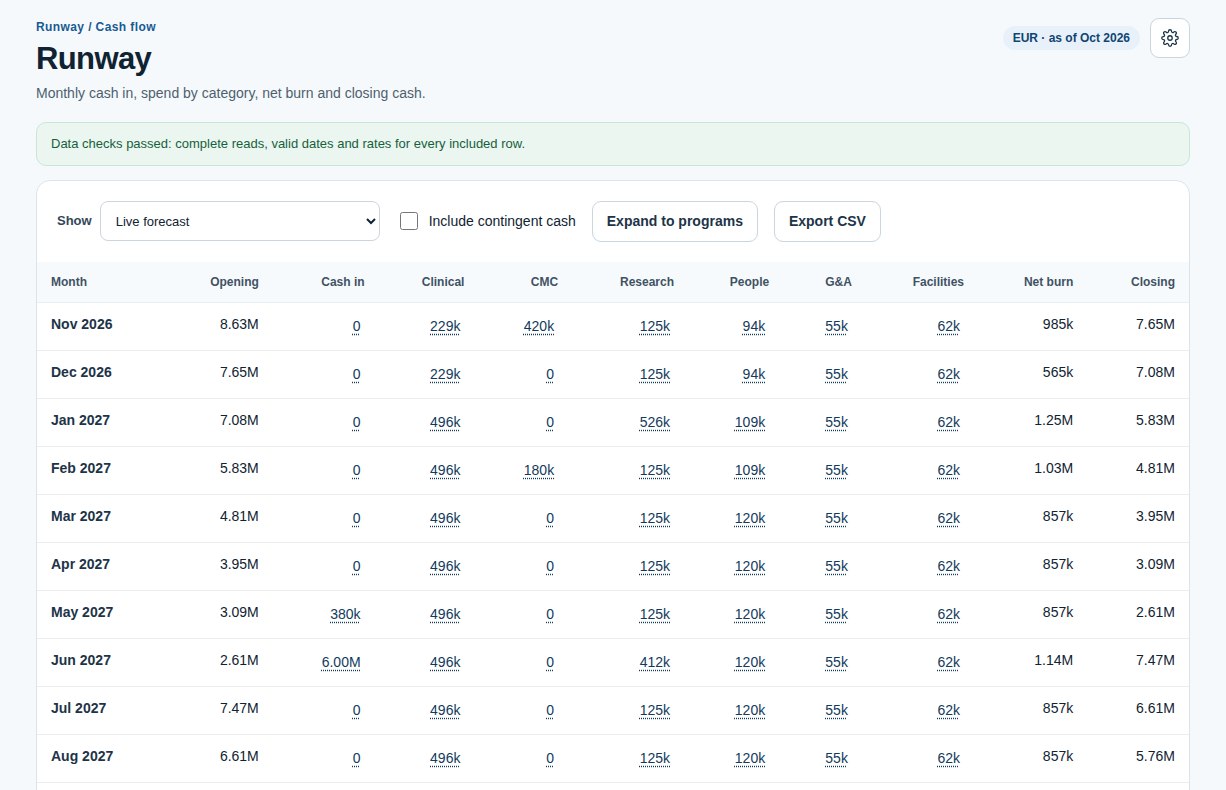
Open Cash flow and select the live forecast. Inspect the Clinical category and drill into the lines behind a payment month. The cross-check is simple: €600,000 minus €120,000 already paid equals €480,000 still scheduled; adding €60,000 of separate costs gives €540,000 of future vendor cash.
| Through month | Company spend | Vendor cash | Closing cash |
|---|---|---|---|
| March 2027 | 270 | 210 | 1,020 |
| June 2027 | 540 | 390 | 570 |
| September 2027 | 810 | 540 | 150 |
Each row is cumulative: closing cash = €1.5 million − company spend − vendor cash. The prior €120,000 must not be paid again in this forward forecast. Doing so would understate September cash as €30,000 rather than €150,000. Adding the €600,000 contract total on top of the instalments would create an even larger duplicate.
This example excludes receipts, financing, taxes, currency movements and other costs. All amounts are EUR; payment dates are assumed, not predicted. Runway is monthly, so these balances do not establish whether cash is sufficient on every day of the month.
Keep a reviewed payment plan as evidence changes
With an authorized ChatGPT or Claude connection, ask the assistant to map a supplied payment schedule into proposed Runway inputs. Available app surfaces and actions depend on the host; there is no built-in contract parser or automatic bank reconciliation.
“Reconcile this agreement to payments already made as of our opening balance. Show the remaining instalments and separately identified reimbursable costs. Check existing Plan lines before proposing records, flag unclear deposit credits, and leave forecast calculations to Runway.”
If your team needs a procurement approval view, TrialAgents can support a reviewed app customization or a bespoke app. Shared agreement and organization records can be reused through explicit authorized bindings; they do not automatically create payment forecasts or synchronize contract changes.
Clinical operations validates scope and milestones. Finance validates amounts, credits and expected cash dates, then approves the proposed records. Runway’s review and record-version checks help prevent unreviewed or conflicting edits. Keep invoice approval and payment execution in their existing systems.
When dates change, use the CRO payment-timing walkthrough; when the trial itself runs longer, use the trial-extension example. A forecast adjustment does not amend the agreement. Reconcile actual payments at monthly close and revise only the remaining assumptions.
Start with Runway
Build a monthly cash plan from the vendor payments your team has reviewed.
Start with Runway →