
Clinical trial planning · Series D
How to forecast a clinical trial delay: separate deferred payments from extra months
A later invoice can make June cash look healthier while an extended trial leaves September cash much tighter. Model both effects before presenting the new runway.
First-party TrialAgents guidance. The amounts below are fictional and independently calculated, not industry benchmarks or results from a completed Runway or assistant-host test. Screenshots show the genuine browser demo with separate data.
Separate a later date from a longer activity
Our starting question is: which work continues during the delay, and which payment simply moves? A postponed final payment changes cash timing. Three extra months of ongoing trial operations change total cash needed. Moving the payment alone does not answer whether you can fund the longer trial.
The FDA’s clinical research overview identifies study duration and the timing of assessments as protocol design elements. Finance still needs the clinical team’s revised dates and the vendor’s payment terms; a calendar change is not evidence that every cost moves with it.
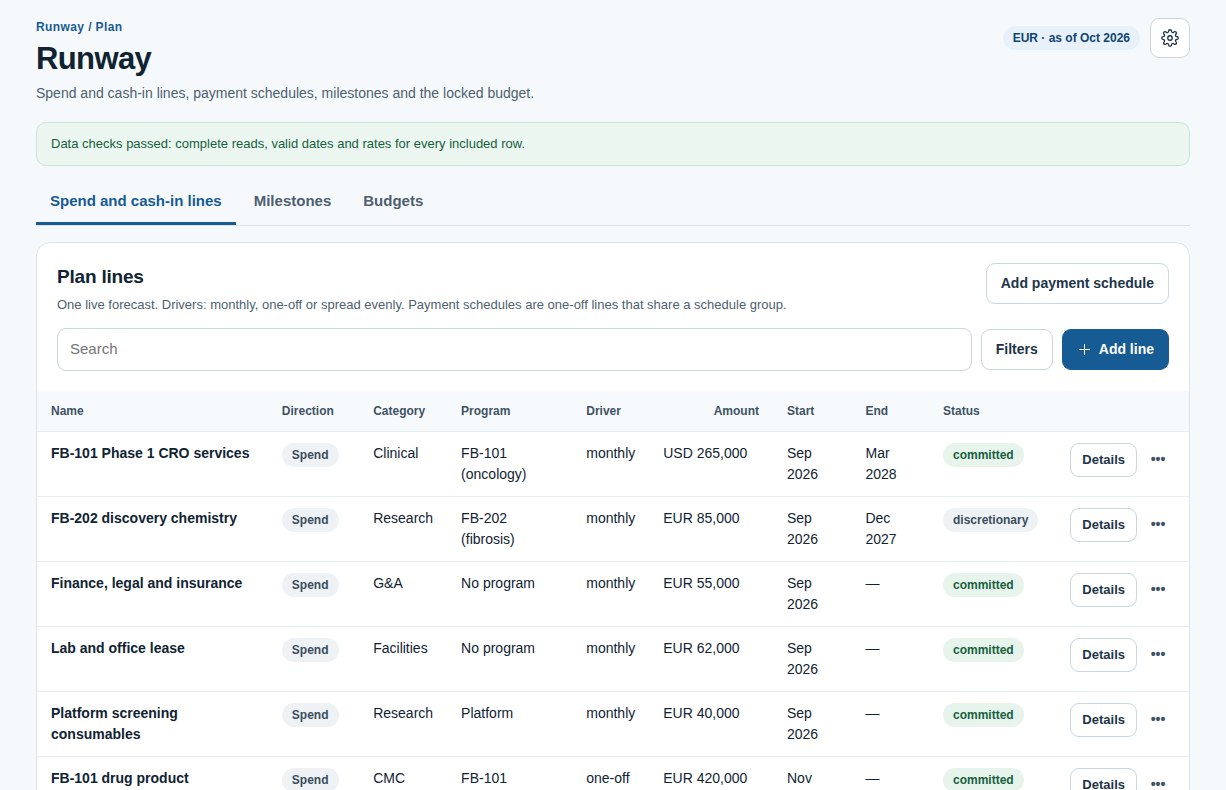
In TrialAgents Runway, translate those decisions into monthly Plan lines, one-off payments and milestones. Keep the original forecast available for comparison. For this worked method, use separate authorized baseline and revised planning apps with identical opening inputs; do not overwrite the approved baseline to try an idea.
Runway’s Shift program scenario moves program dates and linked spend, positions and milestones. It is useful for a whole-program shift, as our CRO payment-timing example shows. It is not an “extend this ongoing trial” control. Here, change the affected Plan end month and payment month explicitly.
Build a baseline and an explicit extension case
Set opening cash to €2 million at 31 December 2026, all in EUR. The baseline contains €100,000 of company spend each month, €80,000 of monthly trial operations from January through June, and a €300,000 final package payment in June. An internal trial-review milestone is planned for June.
For the delay case, keep January as the trial operations start month and extend its end month to September. Move the one-off payment and the Runway-owned review milestone to September. Leave company spend unchanged through January 2028. That company line already includes internal people costs; adding the same salaries in People would count them twice.
| Input | Baseline | Delay case |
|---|---|---|
| Company spend | €100k monthly, Jan 2027–Jan 2028 | Unchanged |
| Trial operations | €80k monthly, Jan–Jun 2027 | €80k monthly, Jan–Sep 2027 |
| Final package payment | €300k one-off, Jun 2027 | €300k one-off, Sep 2027 |
| Internal review milestone | Jun 2027 | Sep 2027 |
Use monthly for the recurring line: Runway applies that amount in each active month. Do not use “spread” to represent a monthly rate; spread divides a total across the selected months. The review milestone is a planning date, not a promise of a scientific result or regulatory decision.
Compare cash on the same date—and at each milestone
A payment-only case is a useful diagnostic: move €300,000 from June to September but leave trial operations ending in June. It shows why a better June balance can be misleading. It is deliberately incomplete as a forecast of this extended trial.
| Month | Baseline | Payment only | Extension + payment |
|---|---|---|---|
| Jun 2027 | 620 | 920 | 920 |
| Jul 2027 | 520 | 820 | 740 |
| Sep 2027 | 320 | 320 | 80 |
| Oct 2027 | 220 | 220 | −20 |
| Jan 2028 | −80 | −80 | −320 |
By September, payment timing alone has no remaining cash benefit: both cases have paid the same €300,000. The extension costs 3 × €80,000 = €240,000, leaving €80,000 instead of €320,000 on that common date.
The milestone comparison answers a different question. Baseline cash at the June review is €620,000; delayed cash at the September review is €80,000. The €540,000 difference includes three more months of company spend (€300,000) and trial operations (€240,000). Do not add the final package payment again: it is already included in both balances.
With these inputs continued, the first negative month moves from January 2028 to October 2027. Runway’s cash-out month means first negative cash, not the first reserve breach. This monthly model says nothing about payment sequencing within a month.
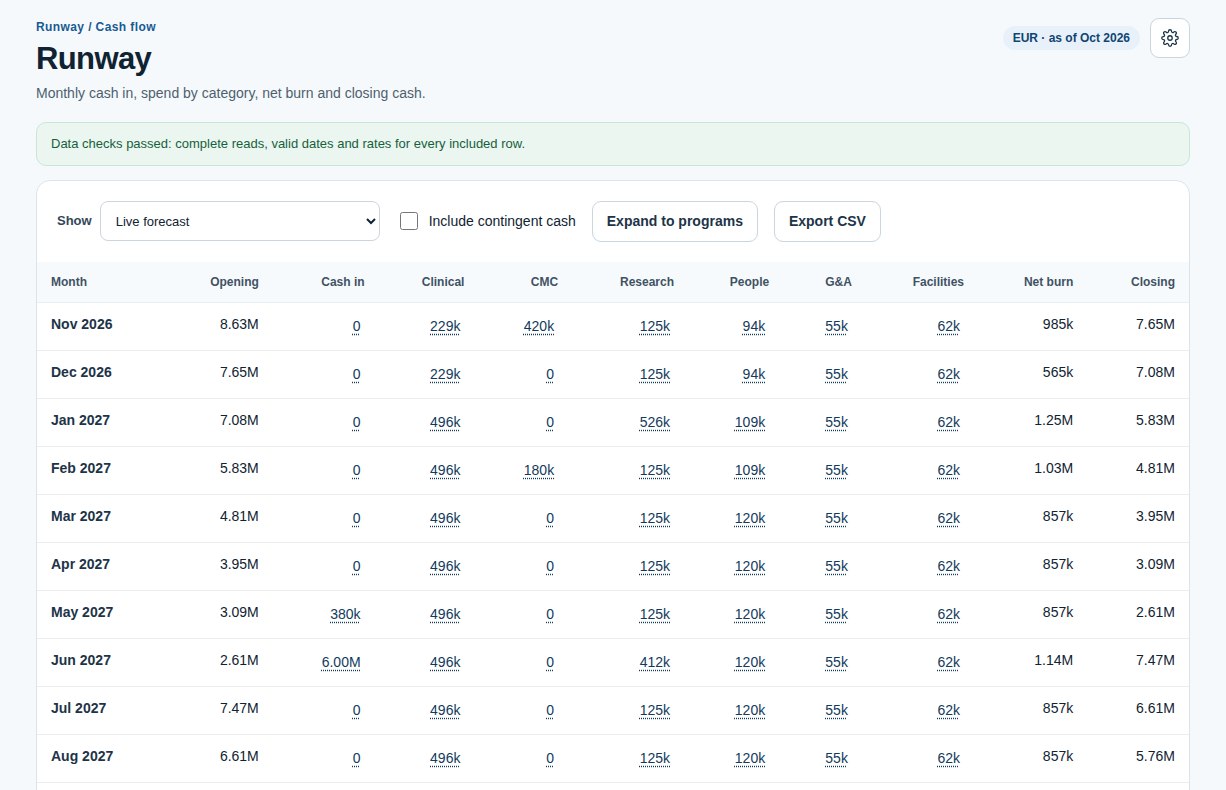
The calculation is opening cash minus cumulative monthly spend and the one-off payment. It assumes no receipts, financing, tax, debt, currency effects or other costs. These are teaching assumptions, not estimates of delay probability or clinical trial cost.
Review the changed inputs before accepting the forecast
In an authorized ChatGPT or Claude connection, ask the assistant to inspect the affected records and propose the specific changes. App-interface availability and supported operations depend on the host; this is a documented workflow, not evidence of identical host behavior.
“In the revised planning app, keep the baseline opening cash and company spend. Propose extending the €80,000 monthly trial-operations line from June through September, moving the €300,000 payment to September, and moving the internal review milestone. Show the exact affected records before saving. Leave computed forecast outputs to Runway.”
If the team needs a dedicated delay-assumption review, TrialAgents supports app customization, including whole-app changes. That would be a reviewed customization, not an existing Runway delay wizard. Other apps can supply data through explicitly configured, authorized connections; a shared workspace does not connect every schedule automatically.
Give clinical operations ownership of the revised timeline and finance ownership of payment assumptions. Respect read-only connected milestones: update their authorized source rather than trying to write through Runway. Before adopting changes, confirm input access, the forecast source and complete currency data. After actual spend arrives, use the monthly close and variance workflow to replace assumptions with reviewed evidence.
We would revisit this forecast when the trial schedule, recurring scope or payment agreement changes—not just when the June balance looks better.
Start with Runway
Bring trial dates, ongoing spend and cash timing into one reviewed monthly plan.
Start with Runway →