
Clinical-stage finance · Series D
Financial planning for clinical-stage biotechs: explain the monthly cash variance
A quiet payment month can make the bank balance look healthier without reducing the remaining study commitment. Keep the budget, the close and the live forecast distinct.
First-party editorial: we make TrialAgents Runway. The fictional cash example is independently calculated, not an executed app or host test. Genuine browser demo screenshots contain separate fictional data.
Choose software that keeps three answers visible
A clinical-stage biotech needs to distinguish what it budgeted, what it paid and what it still expects to pay. For a lean sponsor team, that distinction is a useful test of financial planning software: can finance explain a monthly variance without quietly rewriting the original plan?
TrialAgents Runway brings that workflow into supported ChatGPT and Claude connections, with an app interface where the host supports it and continuation in the browser. Customize views or the whole app when needed; connect other apps through explicit shared-data bindings; then use reviewed writes and access controls around the work. Host support and permissions determine the available actions—an assistant connection is not proof of identical behavior everywhere.
Runway fits monthly cash planning, locked budgets, actuals and forecast revisions. A spreadsheet remains useful for a bespoke model; accounting and specialist study systems remain the sources for bookkeeping and detailed operational records. If the requirement is integrated three-statement accounting or invoice-level payables, standard Runway is not that system. The cash-planning software shortlist compares broader workflow choices.
Clinical context matters: FDA's clinical-research overview describes protocols specifying participants, duration and assessments. Our editorial implication is narrower: finance should ask clinical operations whether a payment difference reflects changed work or just changed timing. A bank balance cannot answer that clinical question.
Freeze the baseline, then reconcile the month
Use a separate authorized demo app for this example. Set opening cash to EUR 3 million at 31 December 2026. In Plan, enter monthly cash spend for January and February 2027: Clinical EUR 300,000, CMC EUR 80,000, Research EUR 40,000 and G&A EUR 80,000. All people costs are included in those lines; do not add Positions that count them again. There are no receipts, financing, taxes, debt, FX or other flows.
Review those inputs, then use Plan → Budgets → Lock as budget for 2027 before changing the forecast. This illustrative budget contains only the two months being examined; it is not a complete annual operating plan.
Suppose January's paid cash spend is Clinical EUR 180,000, with the other three categories exactly on budget. Finance confirms closing cash of EUR 2.62 million. Clinical operations confirms that the remaining EUR 120,000 is still owed and is expected to be paid in February; the study scope has not changed. Those are fictional facts of this example, not assumptions to make about a real unpaid invoice.
Read the authorized January source records and locked budget. Map paid amounts to Runway categories and programs, flag ambiguous or missing items, and show the proposed actual records for review. Reconcile opening cash, receipts, payments and closing cash. Do not treat unpaid invoices as paid cash or overwrite a frozen budget or close.
In the app, use Actuals → Close month with the reconciled actuals, closing balance and commentary. Avoid inserting the same actuals twice. The app creates the close and frozen snapshot through review; the assistant must not manufacture its forecast outputs. If a P&L is the starting document, have finance resolve noncash items and timing differences before treating it as cash activity.
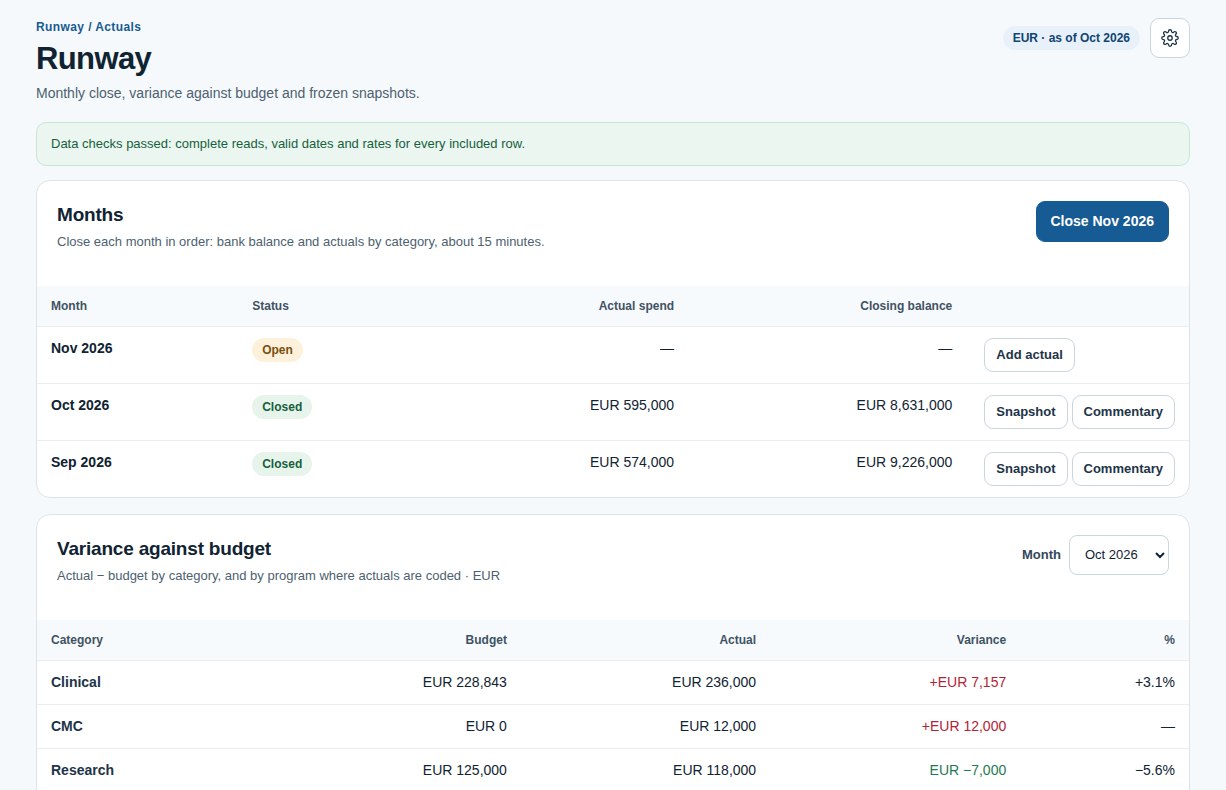
Call the EUR 120,000 difference what it is
| Category | Locked budget | Paid actual | Variance |
|---|---|---|---|
| Clinical | 300 | 180 | −120 |
| CMC | 80 | 80 | 0 |
| Research | 40 | 40 | 0 |
| G&A | 80 | 80 | 0 |
| Total | 500 | 380 | −120 |
Independently calculated: EUR 3m − EUR 380,000 = EUR 2.62m closing cash, compared with EUR 2.5m under the original budget. Cash is EUR 120,000 higher, but the obligation has not disappeared.
Record the explanation in close commentary: “EUR 120,000 clinical payment moved to February; scope unchanged; payment expectation confirmed by finance and clinical operations.” Retain the supporting evidence in the appropriate source system. Runway is not an accounts-payable ledger, and commentary does not settle or amend a contract.
Do not label the negative spend variance a permanent saving. In this example it is a timing difference. A real saving, delayed work and an incomplete actuals import need different explanations and different forecast changes. When the evidence is incomplete, leave the cause unresolved rather than presenting a reassuring total.
Update the future without changing the history
Preserve the January close and locked budget. In the live Plan, represent the unpaid EUR 120,000 once in February through a reviewed one-off Clinical spend line, linked to the relevant program where appropriate. First inspect existing payment lines so the revision does not duplicate a payment already forecast. Explain the changed assumption in its notes.
February cash spend is now EUR 500,000 + EUR 120,000 = EUR 620,000. From the confirmed January close, EUR 2.62m − EUR 620,000 = EUR 2m at February month-end. That equals the original two-month budget: EUR 3m − EUR 500,000 − EUR 500,000. The apparently better January cash position reverses completely.
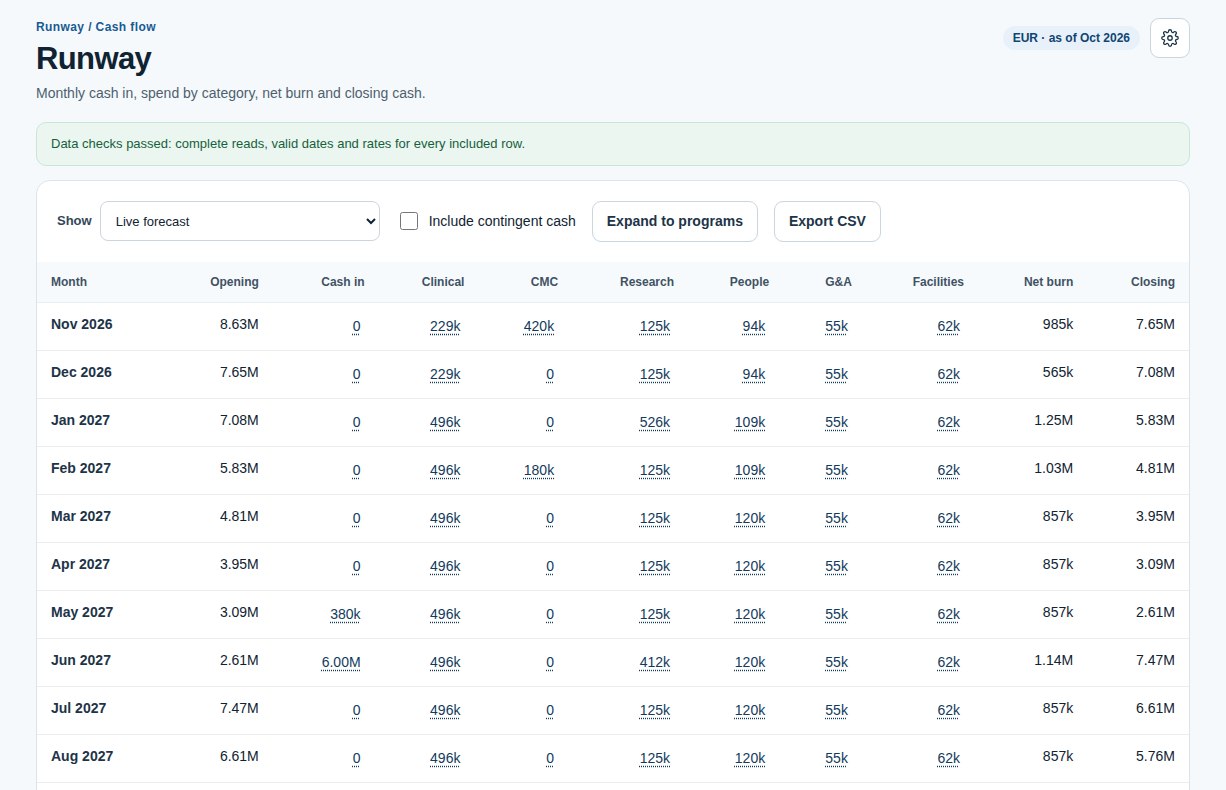
Reopen the saved app and verify the January snapshot, unchanged locked budget and revised February live forecast. Keep the reporting currency and contingent-cash setting consistent. Missing rates, incomplete reads or restricted data must not turn into an exact-looking company total.
This two-month exercise does not establish a full cash-out date. Extend and reconcile the remaining plan before using runway figures for a decision. Standard Runway is monthly, with no bank feed, automatic document parser or 13-week liquidity model. Finance owns reconciliation; clinical operations owns the work-status explanation; leadership owns spending decisions. For moving an existing workbook into this process, use the reviewed Excel-to-Runway migration guide.
Start with Runway
Bring your approved budget, reconciled month-end cash and remaining commitments. Make the next forecast revision explainable.
Start with Runway →