
Biotech team planning · Series D
Biotech hiring vs outsourcing: compare cash through the handover
A salary and a vendor quote cover different things. Compare the same work, start dates and planning horizon—including the external support needed before new hires can take over.
First-party TrialAgents guidance. All worked amounts are fictional, independently calculated assumptions, not salary benchmarks, vendor quotes or a completed app/host test. Screenshots show the genuine Runway browser demo with separate data.
Define the work before comparing the spend
Imagine a small biotech deciding how to cover a clinical operations work package during 2027. One option retains external support all year. The other uses that support until two hires take over in April. In TrialAgents Runway, those choices become vendor lines in Plan and planned positions in People.
First agree the deliverables, capacity, start dates and handover conditions. Two employees are not automatically equivalent to a vendor team. Leadership must assess expertise, supervision, continuity and delivery risk separately; a cash model cannot prove those are equal.
Salary alone is an incomplete employer-cost measure. The US Bureau of Labor Statistics’ compensation framework distinguishes wages and salaries from employer benefit costs. Use your own approved payroll assumptions: its averages are not a biotech-specific loading rate, and our fictional 25% below is not derived from them.
“What cash remains at the same year-end if we retain the vendor, versus hire and fund the transition?” Then test a later hiring date. Do not assume vendor payments stop just because a position starts.
Put people in People and vendor commitments in Plan
Use separate authorized planning copies with the original baseline preserved. Both start with €1.8 million at 31 December 2026 and €100,000 of monthly company spend through December 2027. That shared line includes the existing team but excludes the two proposed hires and this work package.
| Input | Retain vendor | Hire in April |
|---|---|---|
| External support | €30k monthly, Jan–Dec | €30k monthly, Jan–Mar |
| Vendor setup payment | €10k in January | None assumed for existing bridge support |
| New positions | None | Two at €120k annual salary each, Apr–Dec |
| Employer-cost loading | Not applied to vendor fee | 25% on salaries |
| Recruitment/onboarding | None | €20k one-off in April |
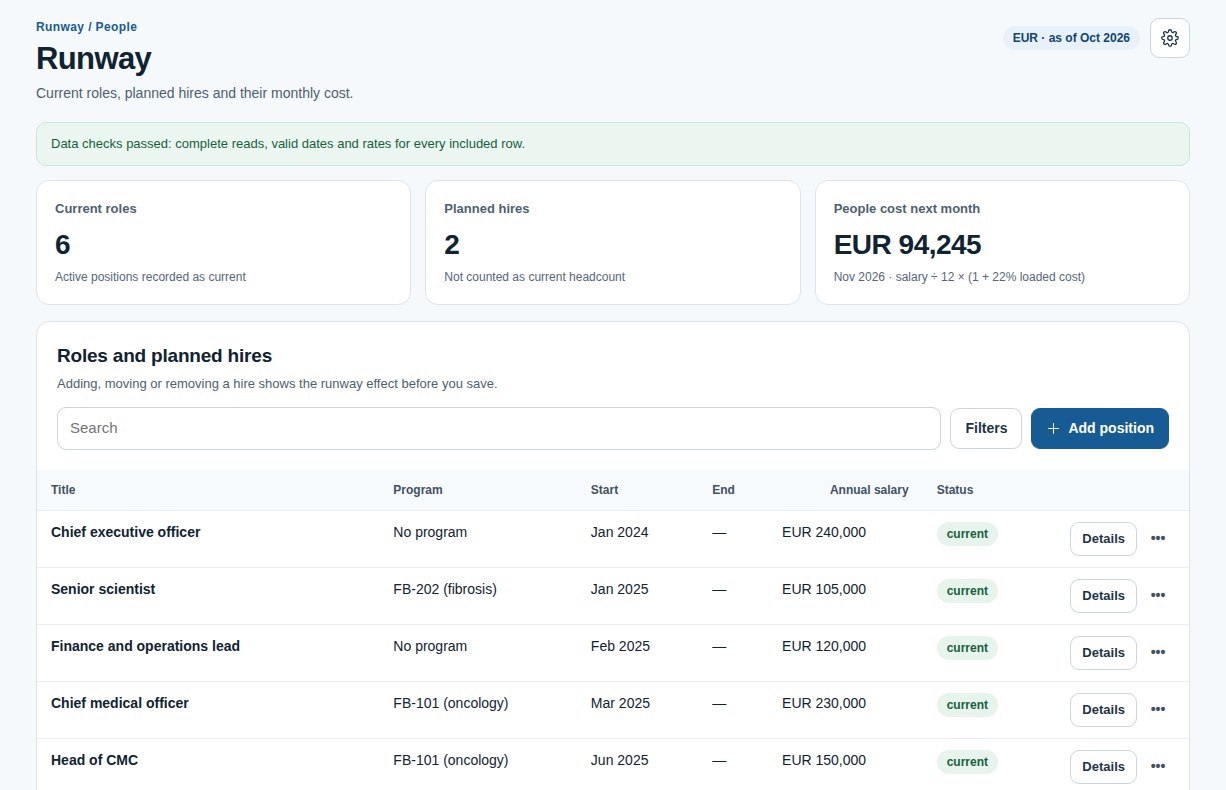
In the hiring plan, add two planned positions in People. Runway calculates each active month as annual salary ÷ 12 × (1 + loaded-cost percentage): €120,000 ÷ 12 × 1.25 = €12,500 per person, or €25,000 for both. End dates here define the comparison horizon, not an assumption that employment ends in December.
The loaded-cost percentage is a Settings value used for positions, not a separate tax calculation for each role. Review its effect on any other positions before changing it. Enter recruitment costs and temporary vendor support as Plan lines; do not enter the same salaries again in Plan. Confirm what the loading already includes before adding benefits separately.
Read the full-year cash difference, then move the handover
In Cash flow, select each plan’s live forecast and compare the same month. The vendor option costs €30,000 × 12 + €10,000 = €370,000. The hiring option costs €90,000 of bridge support + €225,000 of loaded salaries + €20,000 of recruitment = €335,000.
| Month | Retain vendor | Hire in April | Hire in July |
|---|---|---|---|
| March 2027 | 1,400 | 1,410 | 1,410 |
| June 2027 | 1,010 | 1,015 | 1,020 |
| September 2027 | 620 | 640 | 625 |
| December 2027 | 230 | 265 | 250 |
The April hiring case leaves €35,000 more at year-end. Now move the positions and recruitment payment to July and extend vendor cover through June. The delayed-hire case costs €180,000 of support + €150,000 of salaries + €20,000 of recruitment = €350,000. It leaves €250,000: €15,000 less than hiring in April, despite fewer salary months.
That sensitivity assumes the vendor can extend at the same rate and hand over without overlap. Validate both assumptions; add contractual notice periods, overlap or extra setup costs when applicable. A forecast date change does not cancel a vendor obligation.
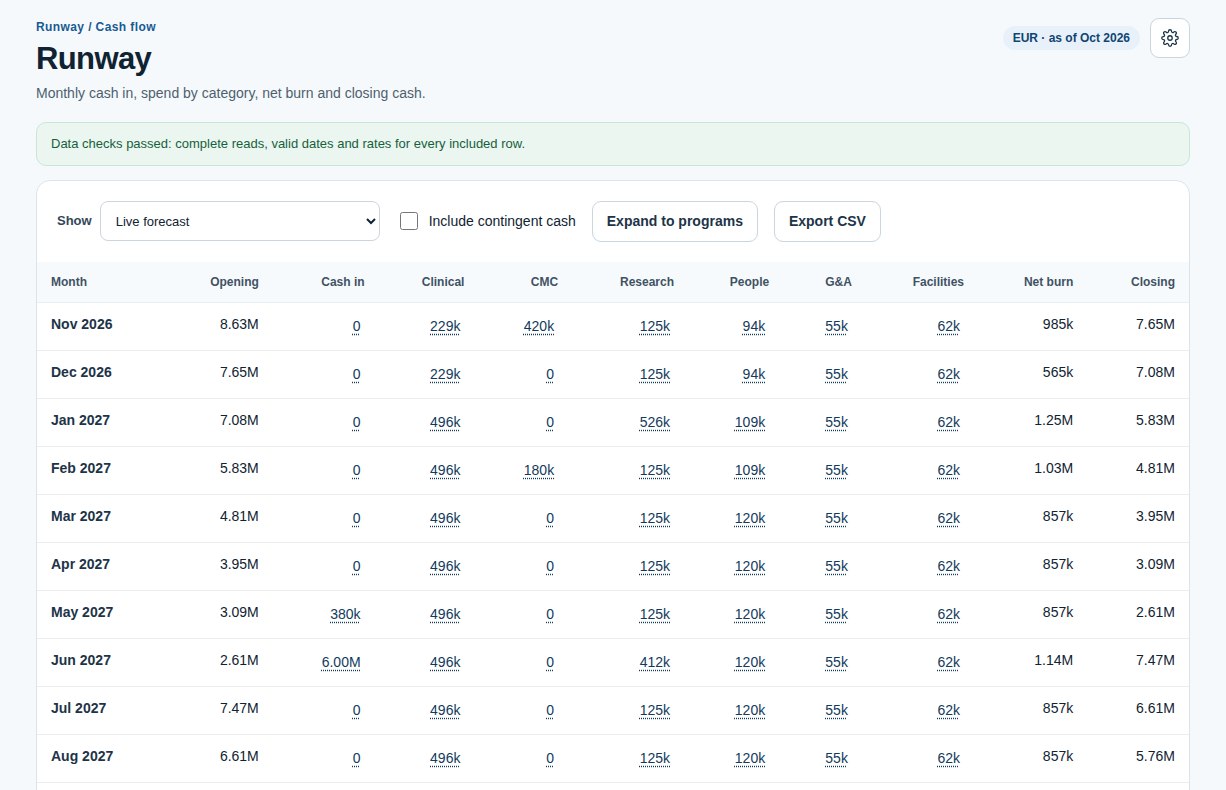
Closing cash equals opening cash minus company spend minus the selected work-package costs. No receipts, financing, currency movements, taxes outside the assumed loading, severance or other costs are included. This monthly, twelve-month comparison does not establish exact-day liquidity or cash-out after December; extend both plans consistently before drawing that conclusion.
Let the assistant prepare inputs; keep the decision accountable
In an authorized ChatGPT or Claude connection, ask for the proposed People and Plan changes and a reconciliation before saving. Host-specific app surfaces and operations differ; this workflow is not evidence of identical host behavior.
“Compare retaining our vendor through December with two hires starting in April. Show salary loading, recruitment, vendor notice and handover costs separately. Check for duplicated salaries. Then propose a July-start case with vendor cover extended. Leave calculated forecasts to Runway.”
TrialAgents can support a reviewed customization for a hiring decision log or a bespoke workforce workflow. Other apps can provide authorized data through explicitly configured bindings; adding an HR or agreement app does not automatically synchronize headcount and payments.
Finance should validate the cost assumptions, the operational lead should confirm capacity and handover, and leadership should approve the choice. Protect salary columns through database access controls. Restricted inputs can withhold exact live totals; do not ask the assistant to guess them.
Runway’s Add position scenario previews a hiring change, but it does not automatically replace vendor spend or guarantee a handover. Review both sets of inputs. Use the vendor-payment reconciliation guide for commitments and the small-team budgeting guide to keep each cost in one place.
Start with Runway
Compare hiring and vendor commitments in a reviewed monthly cash plan.
Start with Runway →