
Buying guide · Series E
Biotech cash runway software: 15 questions to take into the demo
Bring a small cash model, a restricted user and an exit checklist. Ask each vendor to show the evidence behind the answer.
First-party buying guidance from TrialAgents, reviewed against Runway 2.2 documentation and source. This is a reusable evaluation checklist, not a vendor ranking or completed hands-on comparison. Genuine Runway 2.1 browser demos show separate fictional data.
For a small biotech, the best cash runway software is the one your team can keep accurate between financing decisions. Before the demo, mark your non-negotiables: daily liquidity, monthly program planning, accounting feeds, salary restrictions or a three-statement model. A polished dashboard cannot compensate for a missing requirement.
Can your team operate and control it?
1. What can our assistant actually do?
Ask for a read, a proposed change and its approval in your intended ChatGPT or Claude setup. Separate interactive UI, record changes and background tasks. TrialAgents connects Runway to assistants and the web; app commands depend on platform setup. Without them, use reviewed input proposals and the app’s controls. A vendor’s browser demo does not establish host parity.
2. What happens when our workflow changes?
Request a field or layout change, then ask how a new calculation would be validated and maintained. TrialAgents supports app customization and bespoke apps; that breadth does not make every requested model a standard Runway feature. Keep presentation changes separate from financial logic.
3. Which connections work, and in which direction?
Require the source, supported records, refresh behavior and failure path. Runway can use explicitly linked operational apps, with reviewed additions and updates to Plan; it has no native accounting feed. By contrast, Float documents a one-way Xero connection, with daily or on-demand imports, but excludes purchase orders and tracking categories. “Integrated” is not a complete specification.
4. Can readers see totals without seeing salaries?
Test with the intended reader’s access. Runway uses app-level access and database column restrictions, not per-tab restrictions. Restricting salary inputs can withhold live people costs and live runway; approved snapshots still show their frozen figures. Decide whether that behavior fits your board and operating team.
5. What evidence survives a change or incident?
Ask which actions are recorded, who can inspect them and for how long. NCSC guidance makes audit availability, format and retention explicit buying questions. A frozen forecast is not a security audit trail; neither a screenshot nor a generic “logs” feature proves the coverage you need.
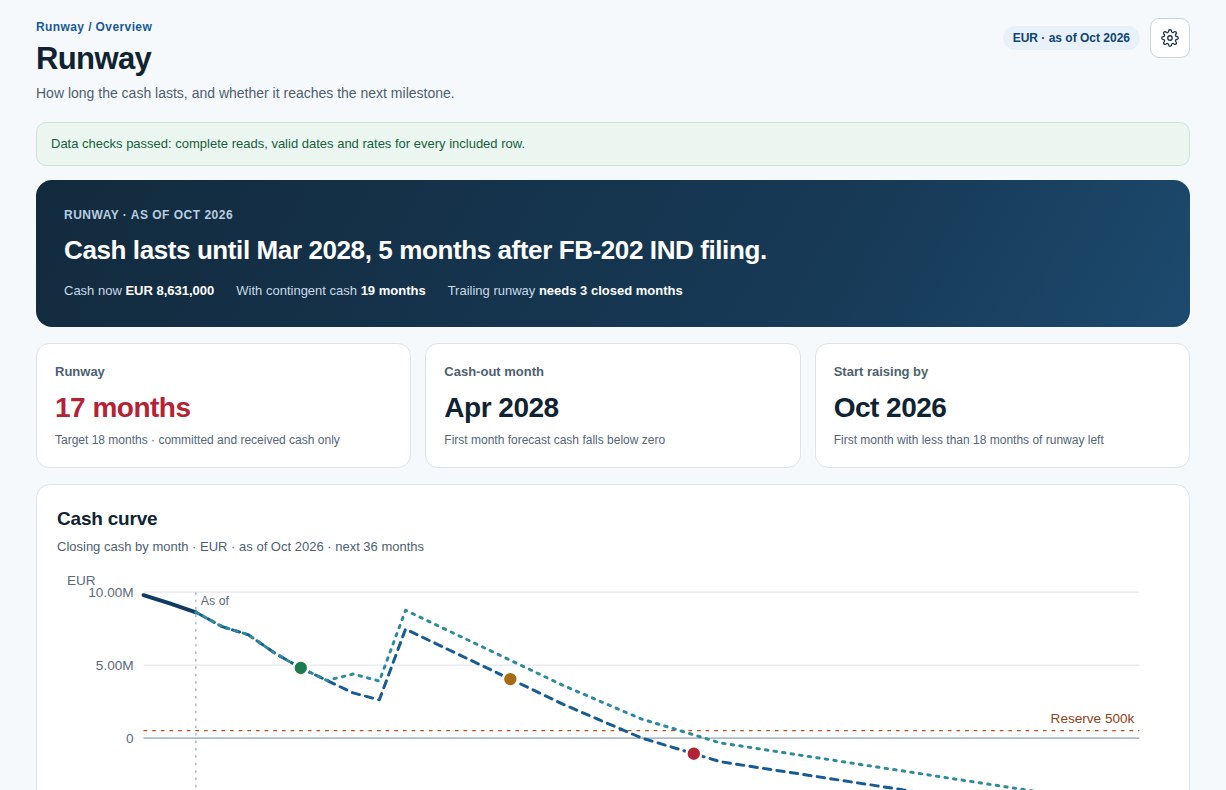
Will the model answer your cash question?
6. What exactly does “runway” mean here?
Ask for the as-of date, included receipts, reserve treatment and cash-out rule. Runway counts full future months with nonnegative closing cash; cash-out is the first negative month. Zero cash is not negative cash, and a reserve target is not the same boundary.
7. Is the time resolution sufficient?
Show a payment due before a receipt in the same month. Runway is monthly: a positive month-end balance cannot prove payment-day liquidity. Require a separate daily or 13-week planning method when that timing is essential. Do not accept a longer forecast horizon as a substitute.
8. Can uncertain funding stay outside the base case?
Use this fictional test: €1 million opening cash at 31 December, €100,000 monthly spend in January–March, an extra €200,000 February payment and a contingent €300,000 March receipt. With no other inputs, March closes at €500,000 excluding that receipt or €800,000 including it. These are independent arithmetic checks, not results from a host test. Ask the vendor to demonstrate both views.
9. Can we trace costs without counting them twice?
Bring one CRO payment, a shared company cost and a hire. Ask how each enters the model and how a total traces to its inputs. In Runway, reconcile Plan and People rather than also budgeting the same salaries inside an aggregate spend line. A program label alone does not establish a complete program budget.
10. What happens when an exchange rate is missing?
Ask to see the warning and the calculation impact. Runway flags missing rates and excludes affected rows; do not read an incomplete result as a saving. Confirm the rates used for closed and future months, and who maintains them. Optional FX automation requires setup and authorized writes.
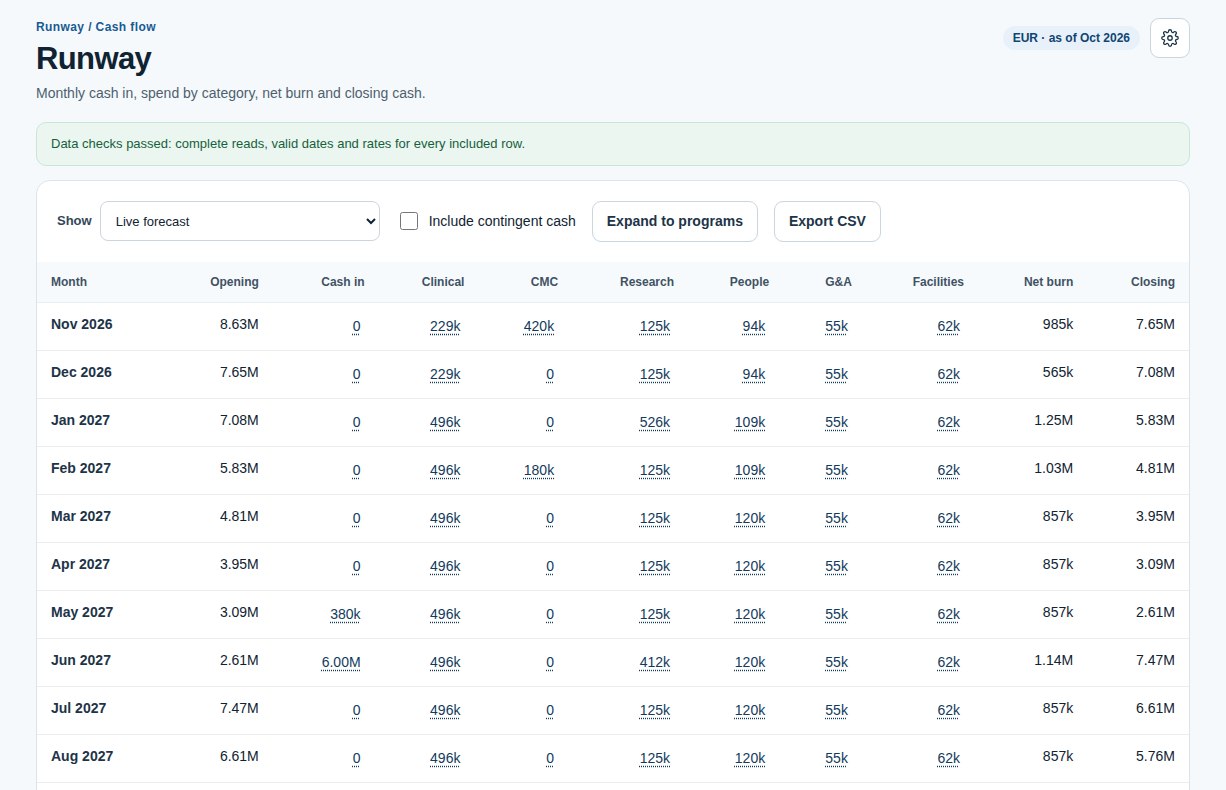
Can you change, reconcile and leave safely?
11. Does a scenario change the live plan?
Request a delayed financing case, then inspect the baseline. Runway separates preview, saved scenario and adoption. Ask what happens if someone edits the underlying plan before adoption; an old scenario should not silently overwrite newer decisions.
12. Can we reproduce last month’s board figures?
Ask for a closed month, its inputs and the current forecast side by side. Runway freezes month-close metrics and locked budgets; live planning can subsequently change. Test the close and reconciliation process using your own representative data before relying on it.
13. What can we export and reconstruct elsewhere?
Inspect an actual export: dates, currencies, program references, assumptions and historical outputs. Runway’s Cash flow export supplies copyable CSV text; platform database tables offer CSV downloads. Neither implies a portable, executable copy of the entire financial model.
14. Who owns implementation and monthly upkeep?
Name the person who maps old data, reconciles opening cash, approves changes and updates actuals. Runway does not automatically translate workbook formulas or parse bank files. Use the dashboard setup checks as an acceptance step, and retain the source records during cutover.
15. What is included in the full commitment?
Get a written scope for users, environments, integrations, implementation, support, exports and renewal or exit terms. Record internal maintenance work as well as vendor charges. This guide supplies no price estimate or implementation-time benchmark; compare current quotes against the same requirements.
Keep an evidence record, not a demo score
Copy this row into your evaluation document for each question. Mark a requirement Demonstrated, Documented only, Needs setup or Unavailable. An unresolved must-have stays unresolved even if the rest of the demo is strong.
| Requirement | Evidence and status | Owner and acceptance |
|---|---|---|
| Example: exclude uncertain financing | Save the demo result and configuration; distinguish a promise from a demonstrated output | Finance owner verifies the €500,000 base and €800,000 contingent case before sign-off |
Shortlist TrialAgents Runway when you want an assistant-connected, customizable monthly biotech planning app with explicit operational connections. If native bookkeeping, integrated three-statement planning or daily liquidity is non-negotiable, require a product that demonstrates it. Apply these same questions to us.
Start with Runway
Bring your requirements and a small test case. Check the workflow before moving your live plan.
Start with Runway →