
Forecast building · Series E
Build a 24-month biotech cash forecast: make year two explicit
A second year of columns is not a second year of assumptions. Set the payment dates, model the step changes, and check what cash remains when the planning window ends.
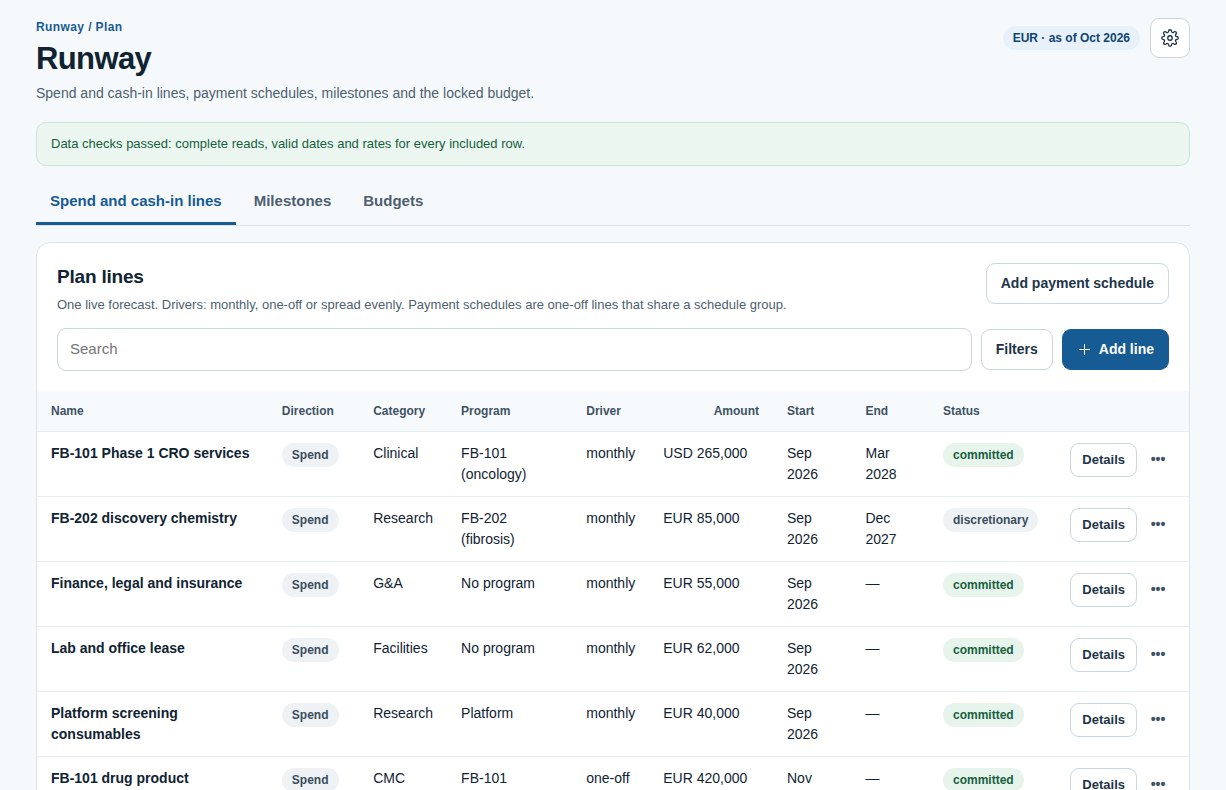
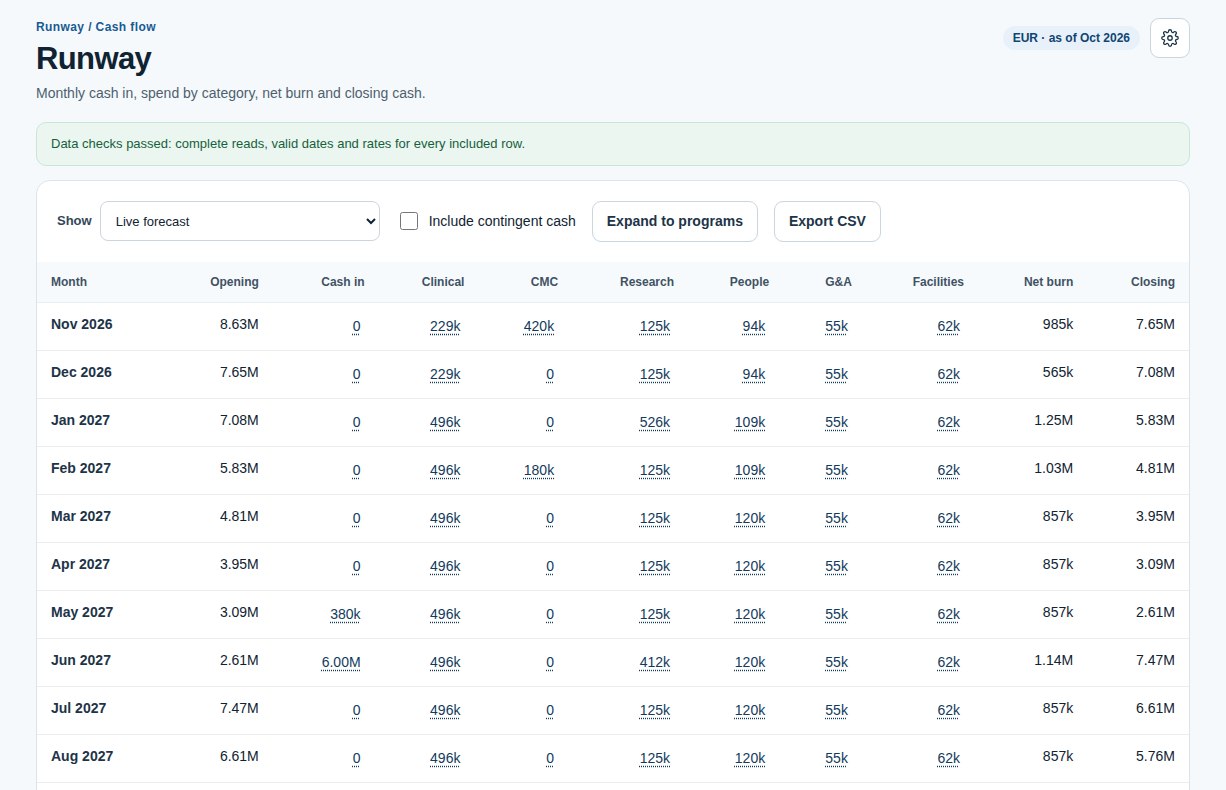
A first-party guide based on Runway 2.2 documentation and source. The fictional example is independently calculated, not a biotech cost benchmark. Genuine 2.1 browser demo images show different data; no assistant host test is claimed.
Separate the forecast window from runway
To build a 24-month biotech cash forecast, start with reconciled cash at a month end, date every expected receipt and payment, and calculate each subsequent month’s closing balance. In TrialAgents Runway, use monthly Plan inputs and inspect the corresponding Cash flow months. Twenty-four months is the period reviewed here, not a claim that cash lasts two years or a special app horizon setting.
Use payment timing, not only the month work is performed. BDC’s forecasting guidance emphasizes when customers pay, additional costs of the business plan, alternative scenarios and regular comparison with actual results. For a pre-revenue biotech, apply that discipline to supplier payments, payroll and any expected funding receipts.
Our example starts with €4.8 million at 31 December 2026 and reviews January 2027–December 2028 in EUR. There are no receipts or FX changes. All payments are in the lines below, including internal people costs within overhead; no separate People positions are added. Real forecasts must also include taxes, equipment, debt payments and other obligations where applicable.
Give year two its own dated assumptions
Create separate monthly lines for each rate period. End the first-year lines in December 2027 and start their replacements in January 2028. Runway’s monthly amounts apply in each month from start through end, inclusive. A one-off belongs in its payment month; a spread amount is a total divided over its selected months, not a monthly rate.
| Spend line | Payment months | Amount |
|---|---|---|
| Company overhead: year one | January–December 2027 | €100,000/month |
| Company overhead: year two | January–December 2028 | €120,000/month |
| Clinical work: year one | January–December 2027 | €50,000/month |
| Clinical work: year two | January–December 2028 | €75,000/month |
| CMC manufacturing payment | One-off, September 2028 | €300,000 |
Year one uses €1.8 million. Year two uses €2.34 million in recurring payments plus the €300,000 CMC payment: €2.64 million. These are assumed payment schedules, not a statement that every biotech’s clinical or manufacturing costs rise this way.
Repeating year-one monthly rates for all 24 months, even with the CMC payment included, leaves €900,000. The explicit second-year rates leave €360,000. That shortcut overstates closing cash by €540,000.
Check the path, not just the final balance
Reconcile the monthly rollforward: opening cash + receipts − payments = closing cash. Total payments here are €4.44 million, so December 2028 cash is €360,000. Against a chosen €300,000 reserve, headroom is €60,000. The reserve is a threshold, not another expense.
For a downside case, add €600,000 to the September 2028 CMC payment, making that payment €900,000. Keep all other inputs unchanged. This tests a specific additional obligation without quietly assuming an uncommitted funding round will cover it.
| Month end | Base | Extra €600k CMC payment |
|---|---|---|
| December 2027 | 3,000 | 3,000 |
| June 2028 | 1,830 | 1,830 |
| September 2028 | 945 | 345 |
| October 2028 | 750 | 150 |
| November 2028 | 555 | −45 |
| December 2028 | 360 | −240 |
The downside falls below the reserve in October and first becomes negative in November. Base cash stays nonnegative within the chosen window. Neither result establishes cash sufficiency after December: ending all input lines then must not be mistaken for the business becoming cost-free. Monthly balances also cannot prove coverage of every payment within a month.
Refresh assumptions when the window moves
With Runway connected in ChatGPT or Claude, ask: “Review our January 2027–December 2028 plan. Identify lines that end after year one, overlapping replacement lines and missing second-year obligations. Prepare the €600,000 September CMC downside for review and compare the app’s calculated balances.” Check available actions and access; approve input changes separately from the analysis.
Customize the app with reviewed fields for assumption owner, evidence or review date. If another TrialAgents app owns programs or obligations, connect it explicitly and review additions or updates to Runway. This does not imply automatic bank, accounting or payroll synchronization.
After closing January, preserve the closed actuals and review the next 24 future months, February 2027–January 2029. Add explicit January 2029 assumptions rather than merely moving a date label. Reconcile actual cash, update remaining payments and retain the prior forecast so the changes remain explainable.
For a simpler starting sheet, our free workbook covers 12 months; it is not a ready-made 24-month download. Use the Excel-to-Runway guide to transfer reviewed assumptions. The useful outcome is a maintained cash plan whose second year has owners and evidence.
Start with Runway
Build a monthly biotech cash plan with explicit assumptions for both years.
Start with Runway →