
Choosing an alternative · Series E
TrialAgents Runway alternatives: when to switch and what to carry over
Choose the missing capability first. Then decide whether to replace your monthly planning app or add a specialist alongside it.
First-party guidance from TrialAgents, based on Runway 2.2 documentation and current vendor sources. These are conditional recommendations, not completed hands-on comparisons. Genuine Runway 2.1 browser demos show separate fictional data.
If your team already plans in TrialAgents Runway, a new dashboard is not by itself a reason to move. A recurring question the model cannot answer is. Our recommendation: write that question down before you shortlist alternatives. “Can we pay on Tuesday?” and “What is our group balance sheet?” call for different products.
Know which Runway workflow you want to keep
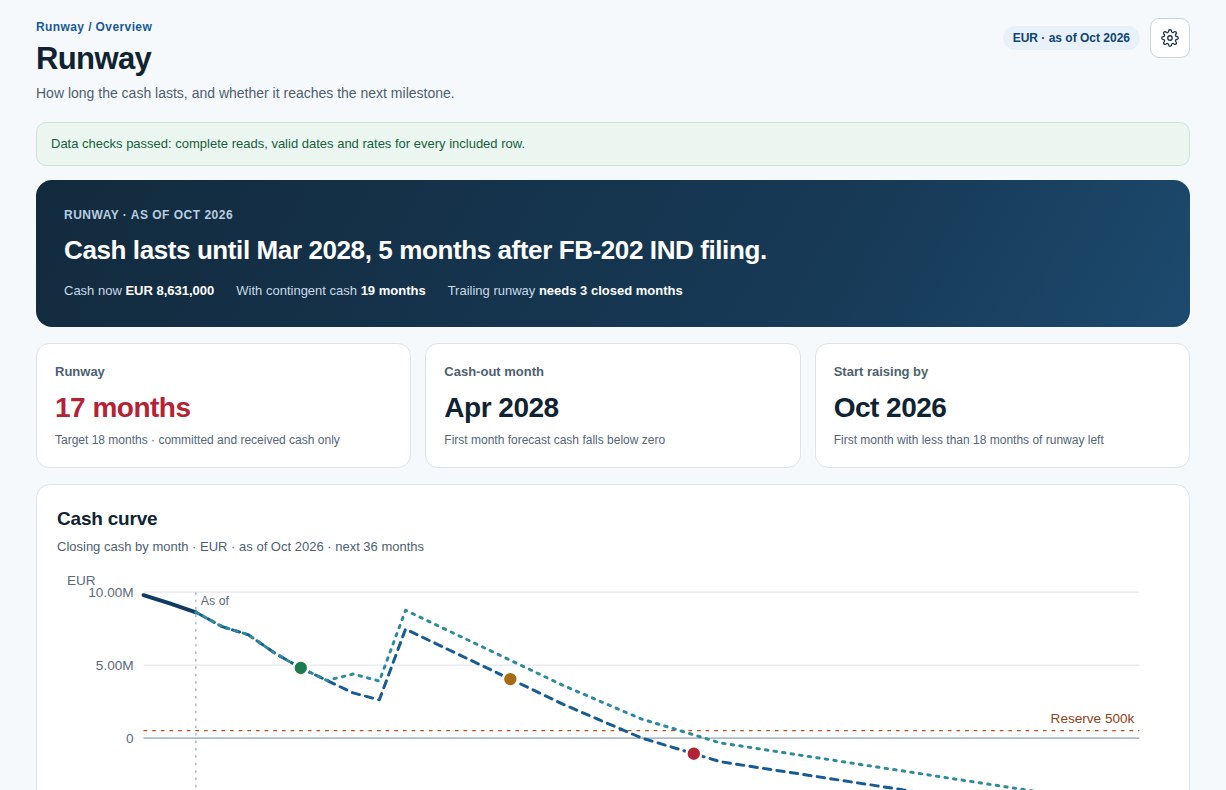
Runway is a monthly biotech cash planning app connected to ChatGPT, Claude and the web. Assistant actions depend on platform setup and permissions; where app commands are unavailable, use reviewed input proposals and the app’s controls. This article does not establish identical behavior in every assistant host.
Its other advantage is adaptability: your team can customize fields, views and app logic. A new financial calculation still needs implementation and validation; customization does not make daily forecasting or three-statement planning a standard feature.
Explicit links to operational apps can bring selected program, CRO, contract or fundraise information into the workflow. Adding items to Plan and accepting later source changes are reviewed steps. These are not native accounting or bank feeds.
Controls matter when you compare replacements. Runway separates scenario preview, saving and adoption; month-close snapshots and locked budgets preserve frozen figures. Access combines app permissions with database restrictions. It is not per-tab access, and restricting salary inputs can withhold live people costs and live runway while approved snapshots retain frozen totals.
Choose an alternative for a specific gap
Float: when payment-day liquidity is the problem
If a positive month-end balance hides a cash shortage earlier in the month, evaluate Float. Its Xero integration documentation describes daily, weekly and monthly cash views and imports of transactions, invoices and bills every 24 hours or on demand. The connection is one-way and read-only; Float does not change Xero. Purchase orders and tracking categories are excluded.
We would evaluate Float alongside Runway when accounting-based payment timing is the missing layer but biotech operating plans still live in Runway. Agree which system owns each forecast and reconcile them; do not imply an automatic connection between the two. Runway’s standard monthly model cannot establish day-level liquidity.
Jirav: when cash must reconcile with profit and the balance sheet
Evaluate Jirav when you need an integrated financial model rather than a cash-only operating view. Jirav documents linked income statements, balance sheets and cash flow statements for historical and future periods. Its cash flow statement is derived indirectly from the income statement and balance sheet.
This is a different model boundary from standard Runway. In a demo, ask your finance owner to trace one accrual, its liability and its eventual payment through all three statements. That is our proposed acceptance check, not a test we performed. Do not assume a Runway CSV contains the accounting structure needed to build that model.
Fathom: when the reporting unit is a group of companies
Evaluate Fathom when your main requirement is consolidated reporting across legal entities. Its consolidated-group guidance covers combined analysis, forecasts and reports after the underlying entities have been imported. Accounts consolidate by matching name and Fathom classification, not account code. Set the historical range carefully: the guide warns that earlier financial data cannot be added to the group later.
Runway program labels are not entity consolidation. Before selecting Fathom, demonstrate your entity structure, account mapping and required adjustments. You may keep an operational planning app alongside group reporting, but give the reconciliation a named owner.
| Your recurring question | Evaluate | Resolve before switching |
|---|---|---|
| Can we meet payments before the next receipt? | Float | Accounting coverage, expected payment dates and refresh timing |
| How do operating assumptions affect all three statements? | Jirav | Model structure and reconciliation to your books |
| What does the group report across entities? | Fathom | Entity imports, mapping and historical range |
| Can we adapt monthly biotech planning around our assistants? | Keep evaluating Runway | Supported actions, permissions and required customization |
Move the meaning of the forecast, not just its rows
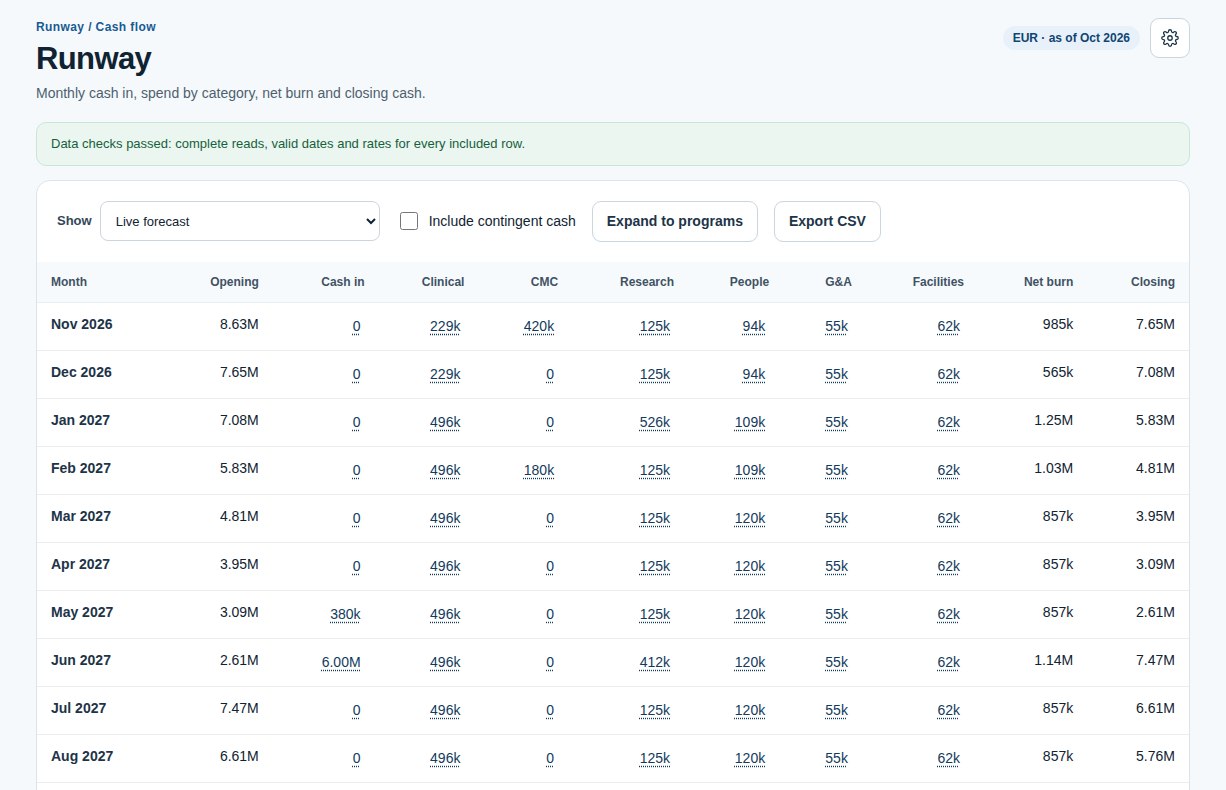
Our handover checklist starts with the last approved reporting position. Record the as-of date, opening cash, currency basis, included funding and the meaning of “runway.” In Runway, runway counts full future months with nonnegative closing cash; cash-out is the first negative month. Another product may use a different definition.
- Current inputs: retain Plan and People records, actuals, source references, expected payment timing and the distinction between committed and contingent cash. Reconcile salaries so they are not also included in aggregate spend lines.
- FX assumptions: retain the rates used and any unresolved missing-rate warnings. Runway excludes affected rows when rates are missing; an incomplete forecast is not a clean migration baseline.
- Approved history: preserve closed-month figures and locked budgets separately from today’s live plan. Do not overwrite an approved board view with a reconstructed forecast.
- Scenarios: identify which cases were merely explored and which changes were adopted. A saved downside case is not automatically the operating plan.
- Access and custom logic: document salary restrictions, reviewed calculations and any configured automations. Recreate and verify the required controls in the destination rather than assuming an export carries them.
Runway’s Cash flow export provides copyable CSV text; platform database tables provide CSV downloads. Neither is a portable, executable financial model. Keep source records and a readable explanation of custom assumptions alongside exports. Ask the destination vendor to demonstrate what it can actually import.
Make one forecast accountable
Before cutover, reconcile opening cash, one closed period and the same future assumptions in both systems. Explain differences caused by timing, scope or definitions rather than forcing totals to match. Verify the intended reader’s access and reproduce one approved historical view. These are recommended checks for your migration, not claims of completed vendor tests.
Replace Runway when the missing model capability is central to your day-to-day work. Add a specialist when the requirement is separate and the team can maintain a clear reconciliation. Keep Runway when assistant-connected, adaptable monthly planning remains the job you need done. Use our 15 vendor questions to test the decision, including our own product.
Start with Runway
Check whether your team’s monthly planning workflow fits before moving live assumptions and history.
Start with Runway →