
Biotech cash planning · Series D
Cash runway software for preclinical biotech: fund the next evidence package
A positive bank balance at the milestone is only half the answer. Use Runway to see what remains after the work—and what a repeat assay would consume.
First-party editorial: we make TrialAgents Runway. This fictional example uses independently calculated monthly balances, not a completed app or assistant test. Genuine browser demo images show different fictional data.
Ask whether the evidence package is funded
For a preclinical biotech, useful cash runway software connects dated work packages to the cash remaining at a decision milestone. An average monthly burn figure can hide the effect of a large laboratory payment. The practical question is: can we pay for the planned work and still retain our chosen reserve?
TrialAgents Runway supports that monthly planning workflow. Start through an authorized ChatGPT or Claude connection, use the app interface where the host supports it, and continue in the browser. Customize the app—including whole-app changes—when the standard view does not fit. Add explicitly configured shared-data connections to other apps, then apply access controls and reviewed changes. Host capabilities and permissions still determine which actions are available.
Here, a fictional team plans a September 2027 evidence review. The FDA describes preclinical research as work that informs whether a drug should be tested in people. Our milestone is an internal review date, not a promise of successful studies, regulatory readiness or authorization to begin a trial. The scientific lead owns the required work; Runway helps finance its timing.
Put the commitments into Settings and Plan
In a separate demo app, set opening cash to EUR 2.4 million at 31 December 2026, reporting currency to EUR and the minimum cash reserve to EUR 300,000. Add a Runway-owned September 2027 milestone for the preclinical program. The reserve is this team's planning choice, not an industry standard.
- Operating spend: EUR 120,000 monthly from January 2027 through January 2028, including all people costs but excluding the two work packages below. Do not add those people costs again as Positions.
- Toxicology package: one-off EUR 600,000 cash payment in March 2027, assigned to the program.
- Analytical package: one-off EUR 300,000 cash payment in May 2027, assigned to the same program.
These are fictional cash-payment assumptions, not vendor quotes or typical preclinical costs. There are no receipts, financing proceeds, taxes, debt payments, other positions or currency conversions in this example. In a real plan, reconcile every amount and payment month to the current contract or finance record; an invoice date or expected study completion is not automatically a cash-payment date.
Open my authorized Runway demo app. Show the proposed Settings, monthly operating line, two one-off program spend lines and September milestone using these assumptions. Identify existing records that would duplicate them. Confirm the dates, currency, status and complete read scope before I approve any writes. Do not add financing or invent missing costs.
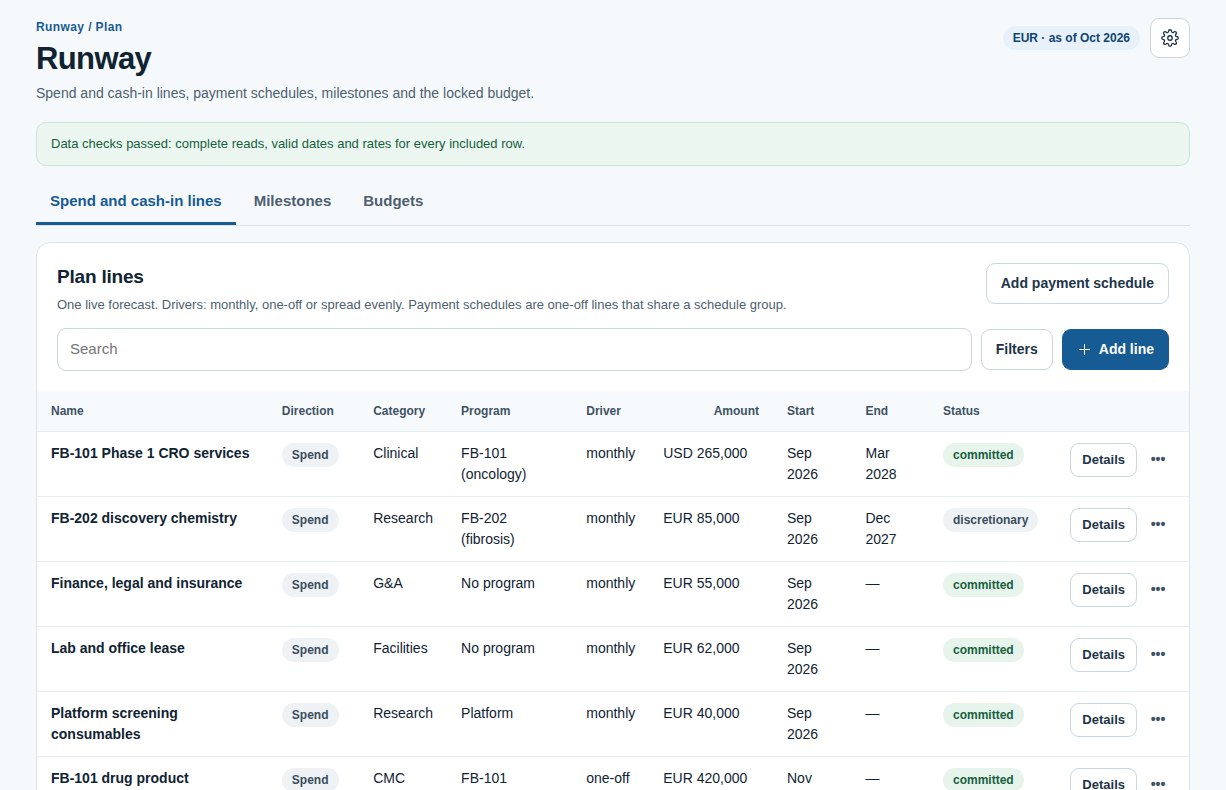
A funded milestone can still leave too little reserve
Now compare a second, explicitly reviewed planning case: an additional EUR 240,000 one-off repeat-assay payment in July 2027. Keep every other assumption unchanged. This is a downside sensitivity, not a predicted probability or a claim that the assay will need repeating.
Use a separate authorized demo plan for this case, preserving the baseline. Add the July line through the normal reviewed Plan flow, then compare Cash flow at the same reporting settings. This exercise does not claim that a standard scenario control creates a new assay line.
| Month | Baseline | With repeat assay |
|---|---|---|
| March 2027 | 1,440 | 1,440 |
| May 2027 | 900 | 900 |
| July 2027 | 660 | 420 |
| September 2027 · review | 420 | 180 |
| November 2027 | 180 | −60 |
| January 2028 | −60 | −300 |
The calculation is opening cash plus receipts minus payments. At September: EUR 2.4m − nine months × EUR 120,000 − EUR 600,000 − EUR 300,000 = EUR 420,000. Subtract the extra EUR 240,000 and the downside leaves EUR 180,000.
Both cases reach the review with positive month-end cash. Only the baseline clears the EUR 300,000 reserve: it has EUR 120,000 of headroom; the downside is EUR 120,000 short. First negative cash occurs in January 2028 for the baseline and November 2027 for the downside. Reserve shortfall and cash-out are different decisions; Runway's cash-out boundary is the first negative month, not the first month below the reserve.
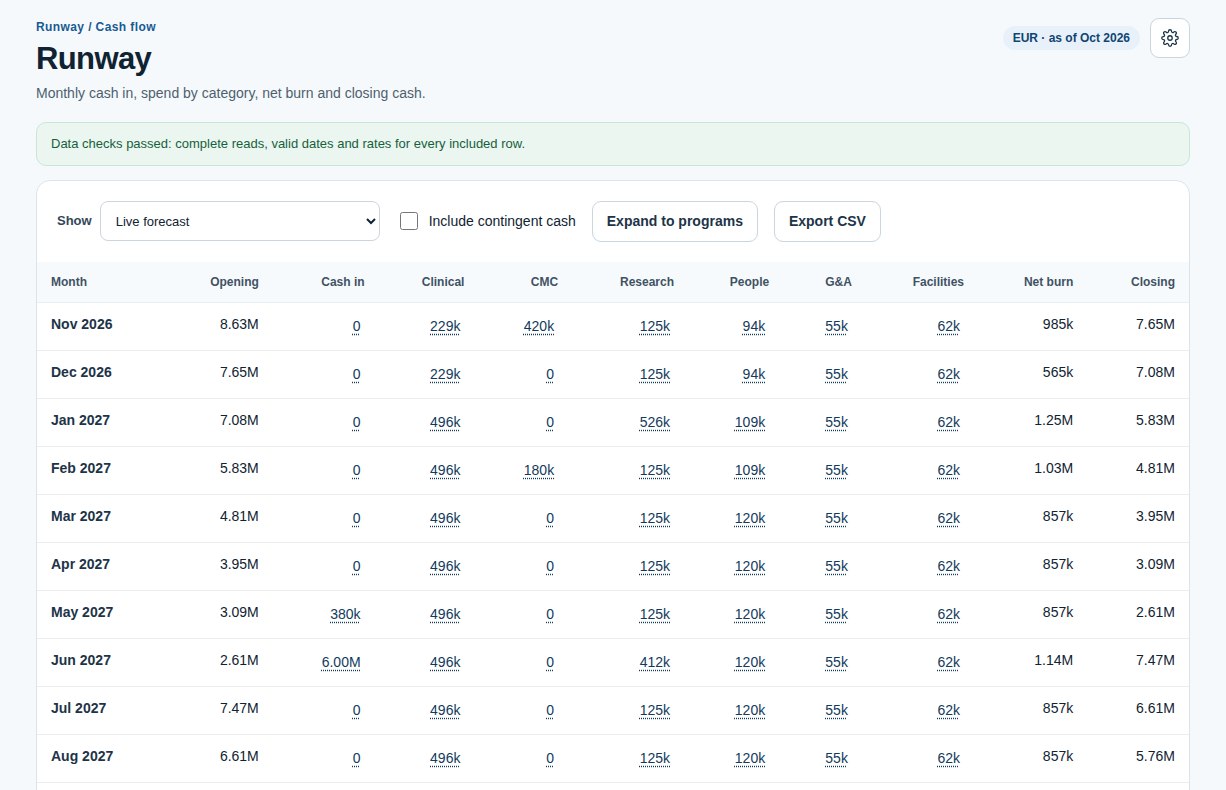
Turn the gap into an owned decision
Before committing the next package, have finance reconcile the saved inputs and monthly output against the calculation. If records are missing or access is incomplete, withhold an exact company total. Ask the scientific lead whether scope or sequencing can change without undermining the evidence objective. Leadership then owns the decision to secure funding, adjust commitments or accept a lower reserve.
Keep uncommitted fundraising separate from committed receipts. A September review is not a guaranteed financing date. When actual payments arrive, use Runway's monthly actuals and close workflow to reconcile the plan; do not overwrite calculated forecasts or frozen snapshots to match an expectation.
This is monthly planning, not intramonth liquidity control. It cannot prove that cash is sufficient on every payment day, and standard Runway does not provide bank feeds, bookkeeping or a 13-week treasury model. For a different question—moving an existing program's timing—see the CRO payment-timing example. Here, the useful result is the reserve gap at the evidence review, with its assumptions and decision owner visible.
Start with Runway
Bring your opening cash, dated work packages and next review milestone. Build a plan your team can inspect before committing the next payment.
Start with Runway →