
Milestone cash planning · Series D
Forecast cash to a Phase I milestone: fund the review, not just the last visit
Define the evidence your team needs, map the payments through that date, and check the cash left afterward. Reaching a milestone with almost no cash is a different result from funding the next decision.
A first-party worked example based on Runway 2.2 documentation and source. Figures and dates are fictional, independently calculated and not trial-cost benchmarks. Images are genuine 2.1 browser demos with different data; no assistant host test is claimed.
Name the decision-ready evidence
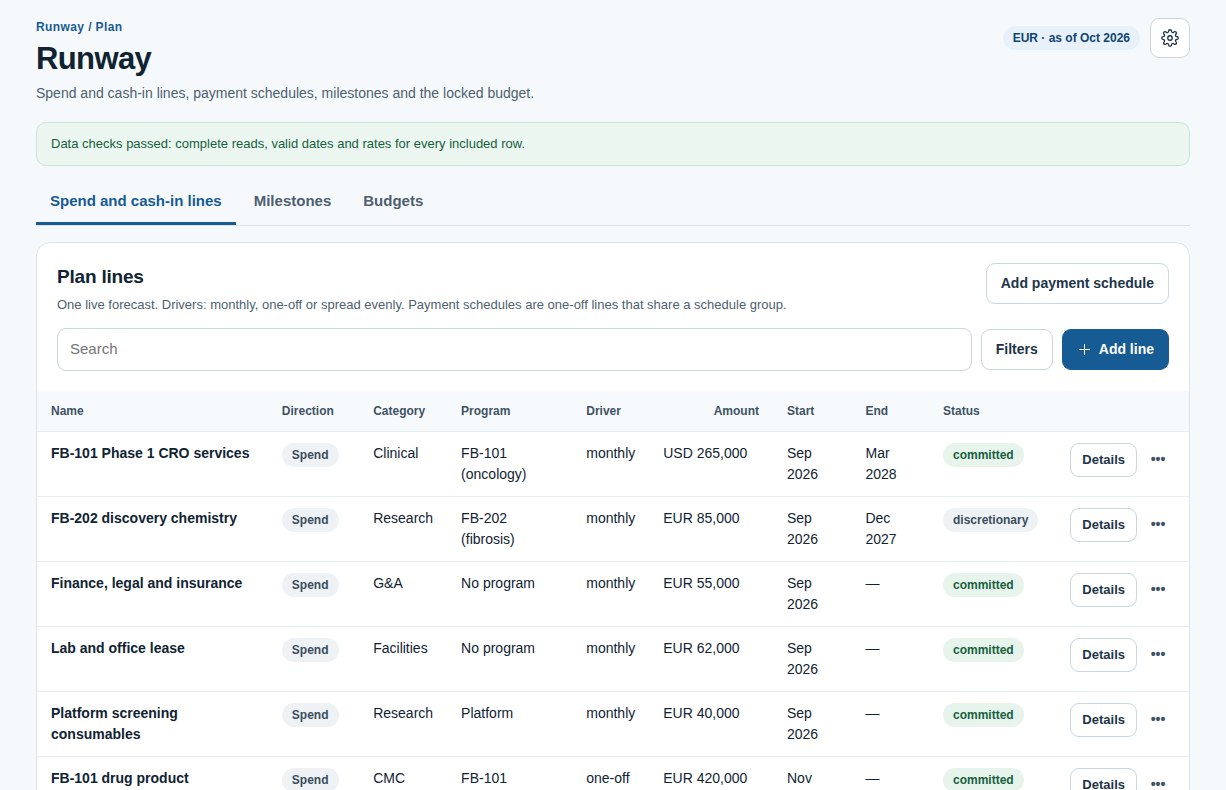
For a biotech preparing a Phase I decision, forecast company cash through the agreed data-review month—not only through the last participant visit. In TrialAgents Runway, record that milestone against the program, enter the payments that lead to it, and inspect the cash balance at the milestone alongside your minimum reserve.
Be precise about dates. ClinicalTrials.gov’s definitions distinguish the final participant examination or intervention used to collect outcome data from later assessment, analysis or interpretation. A registry completion date therefore does not by itself establish when your team will have the evidence needed for a development decision.
In this example, clinical operations expects final participant data collection in June 2027. Laboratory work and analysis follow in July, with a reviewed Phase I data package in August. These are planning assumptions for one fictional study, not standard Phase I timelines. The clinical and scientific leads must define the actual deliverable and acceptance criteria.
“Phase I data package reviewed for the next development decision — August 2027” is more useful here than “Phase I complete.” It identifies the intended output without promising a successful result.
Include the company around the trial
Set opening cash to €2.4 million at 31 December 2026 and the reporting currency to EUR. Add the program and August milestone in Plan. Set an illustrative €300,000 minimum reserve in Settings; this is management’s chosen planning threshold, not a recommended amount for every biotech.
| Spend line | Payment pattern | Amount |
|---|---|---|
| Company staff, facilities and overhead | Monthly, January–December | €120,000/month |
| Program clinical operations | Monthly, January–June | €80,000/month |
| Laboratory and analysis work | One-off, July | €120,000 |
| Data package and report | One-off, August | €60,000 |
Assign the last three lines to the program and leave shared overhead unassigned. All internal people costs are already included in the overhead line; add no People positions in this simplified model. In a real plan, replace the aggregate with detailed lines and positions while counting each cost once.
The program’s direct payments total €660,000 through August. Company overhead over those eight months is another €960,000. Total company payments to the milestone are therefore €1.62 million, leaving €780,000. A program-only budget would miss most of the cash required to keep this company operating.
Test whether the milestone leaves room to act
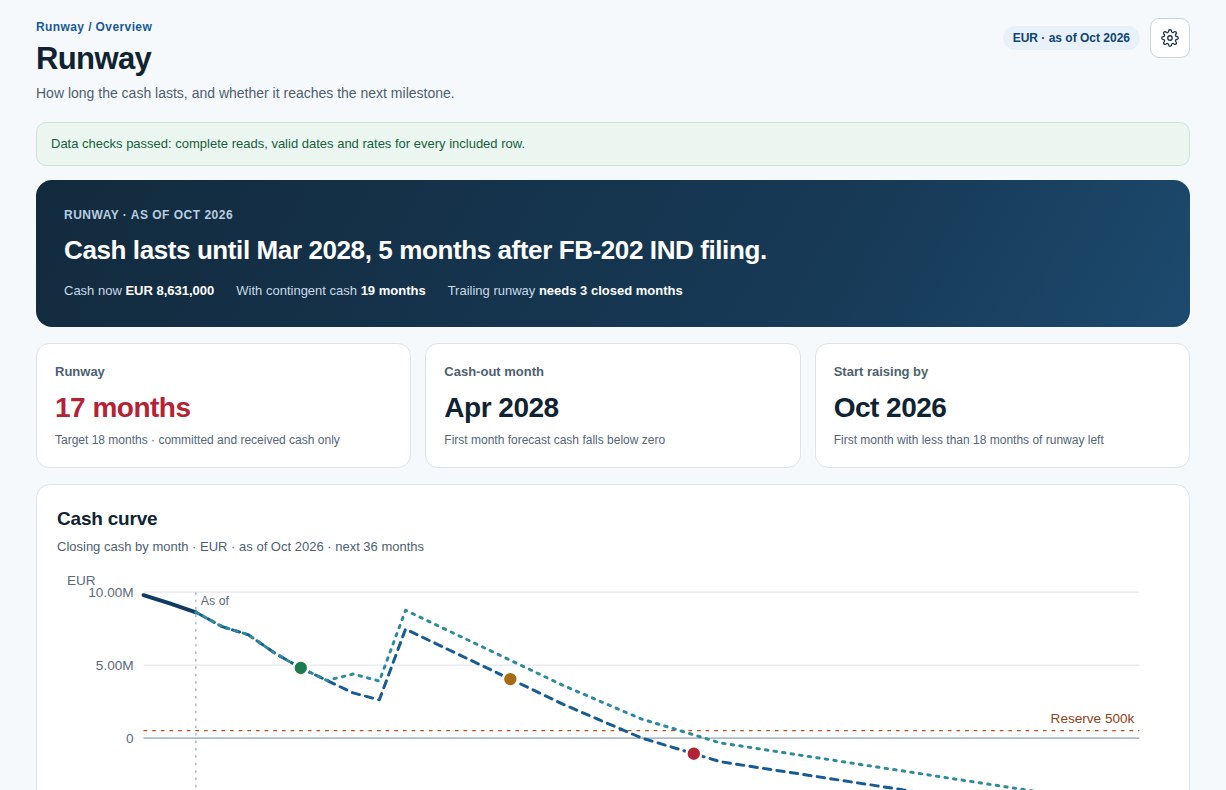
Open Overview to review the milestone and Cash flow to inspect its month-end balance. Runway’s milestone cushion uses the minimum reserve when one is configured; cash reaching zero is a different boundary. The reserve is not an expense or a separate payment deducted from the forecast.
Now consider a later evidence package. Clinical support continues for three additional months, July–September, at €80,000/month. Analysis moves from July to October and the report payment from August to November. The milestone becomes November; company overhead remains €120,000/month throughout.
| Month end | August milestone case | November milestone case |
|---|---|---|
| June | 1,200 | 1,200 |
| August | 780 | 800 |
| September | 660 | 600 |
| October | 540 | 360 |
| November | 420 | 180 |
| December | 300 | 60 |
The original milestone has €480,000 above the reserve: €780,000 − €300,000. At the later milestone, cash is still positive at €180,000, but it is €120,000 below that reserve. The later case even looks slightly better in August because analysis and report payments have moved; that does not make the delayed evidence package better funded.
Both cases exclude new financing, receipts, FX changes, tax payments and costs outside the stated lines. They end in December 2027; no later cash-out date is claimed. This monthly forecast also cannot establish whether cash covers every payment within a month.
Review payments and milestone dates together
With Runway connected in ChatGPT or Claude, ask: “Prepare a review of extending clinical support through September, moving analysis to October and the report to November. Keep company overhead unchanged. Identify the milestone-date update, and use Runway’s cash results to compare the two cases against our €300,000 reserve.” Check available actions and permissions; do not ask the assistant to overwrite derived metrics.
Customize the app with reviewed fields for the milestone’s evidence definition, owner or review date. Connect a Programs app explicitly if it owns the milestone; linked records are read-only in Runway and must be changed in their source app. Linked obligations enter the cash plan only through reviewed additions or updates.
Use targeted changes rather than a blanket program shift: the work already performed in January–June stays in place, while later support and payments change. Clinical operations validates the schedule, finance confirms amounts and contractual payment dates, and leadership decides how to address the reserve shortfall. Keep uncertain financing separate; it is not committed cash.
Preserve the original assumptions before approving a revised plan. A forecast change does not amend a supplier agreement or prove the evidence will support the next phase. Use the board-reporting workflow to present the gap, and the Excel-to-Runway guide to reconcile existing inputs.
Start with Runway
Connect the next Phase I decision to a transparent company cash plan.
Start with Runway →