
Portfolio cash planning · Series D
Cash runway across multiple R&D programs: separate shared costs from savings
A smaller program budget does not automatically mean a smaller company cash outflow. Model the payments that change, and keep the shared costs that remain.
A first-party worked example based on Runway 2.2 documentation and source. Figures are fictional and independently calculated; images are genuine 2.1 browser demos with separate data. No end-to-end assistant test is claimed.
Two programs still draw on one cash balance
Suppose your biotech is advancing a lead candidate while running a second discovery program. The useful question is not which program has the larger allocated budget. It is which payments change if leadership narrows the second program—and what that does to company cash.
In TrialAgents Runway, tag direct spend to its program, keep shared costs visible, and compare the whole-company forecast before and after a specific change. Program reporting explains the total; it does not create a separate bank balance for each program.
Shared costs are a real reporting distinction. In its 2025 Form 10-K, Stoke Therapeutics describes employee, technology, facility and other indirect costs used across programs rather than allocated to individual programs. That is one company’s expense presentation, not a cash-saving rule for your biotech.
Moving a cost between program labels changes the explanation. Changing an actual payment changes the cash forecast.
Give every payment one place in the plan
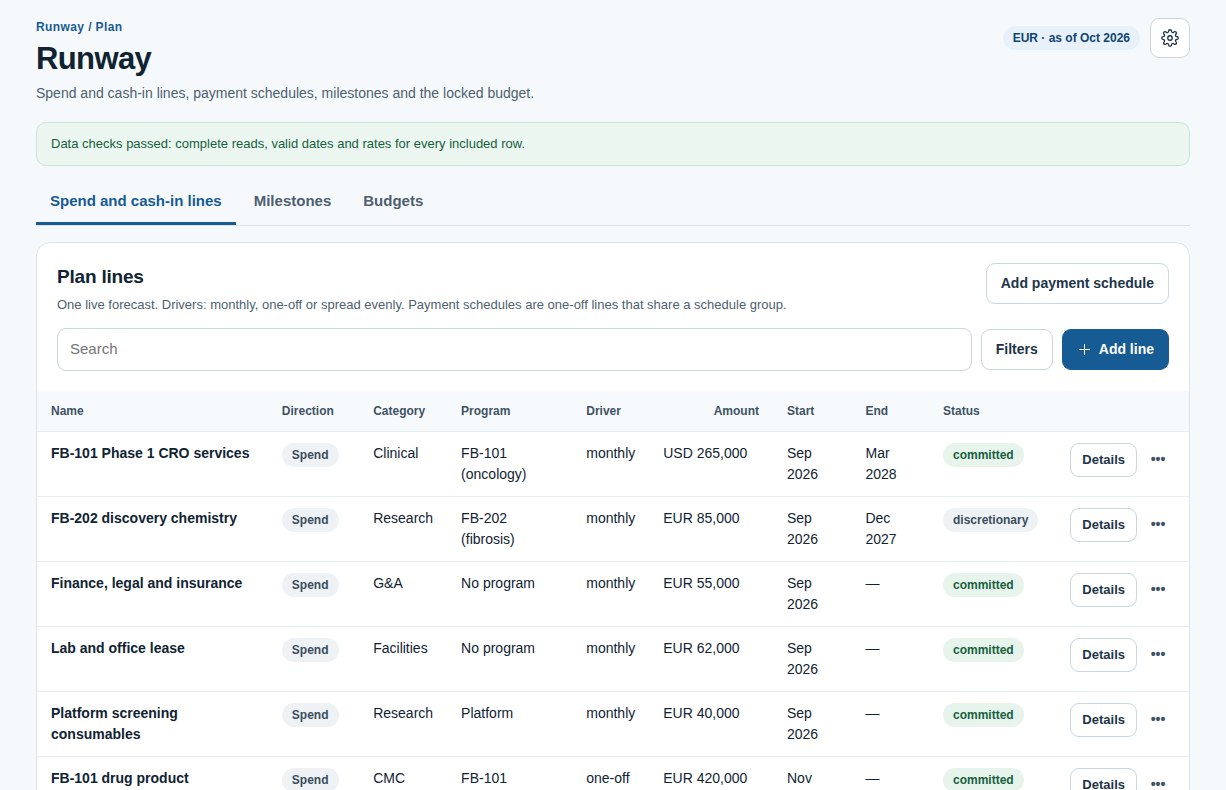
For this fictional example, Settings holds EUR 2.4 million opening cash at 31 December 2026. Add Programs A and B, then enter these monthly Plan lines for January–December 2027, with inclusive start and end months.
| Line | Program assignment | Amount |
|---|---|---|
| Lead-candidate external work | Program A | €90,000 |
| Discovery external work | Program B | €60,000 |
| Shared staff, facilities and company overhead | No program | €70,000 |
| Company total | All three lines | €220,000 |
The shared line includes every internal people cost in this simplified example. Do not add those salaries again in People. In a more detailed model, replace that aggregate with individual lines and positions while preserving the same total.
In Cash flow, use the program breakdown and drill into the spend cells. Reconcile Program A, Program B and unassigned payments to the company total. An unassigned line can be a deliberate shared cost or a mapping omission; finance should know which.
This example has no cash receipts, FX changes, tax payments outside the stated amounts, reserve or other costs. There are no program-linked positions or milestones in the calculation. The comparison ends in December; it does not assume the same spend continues indefinitely.
Change Program B without discounting the shared team
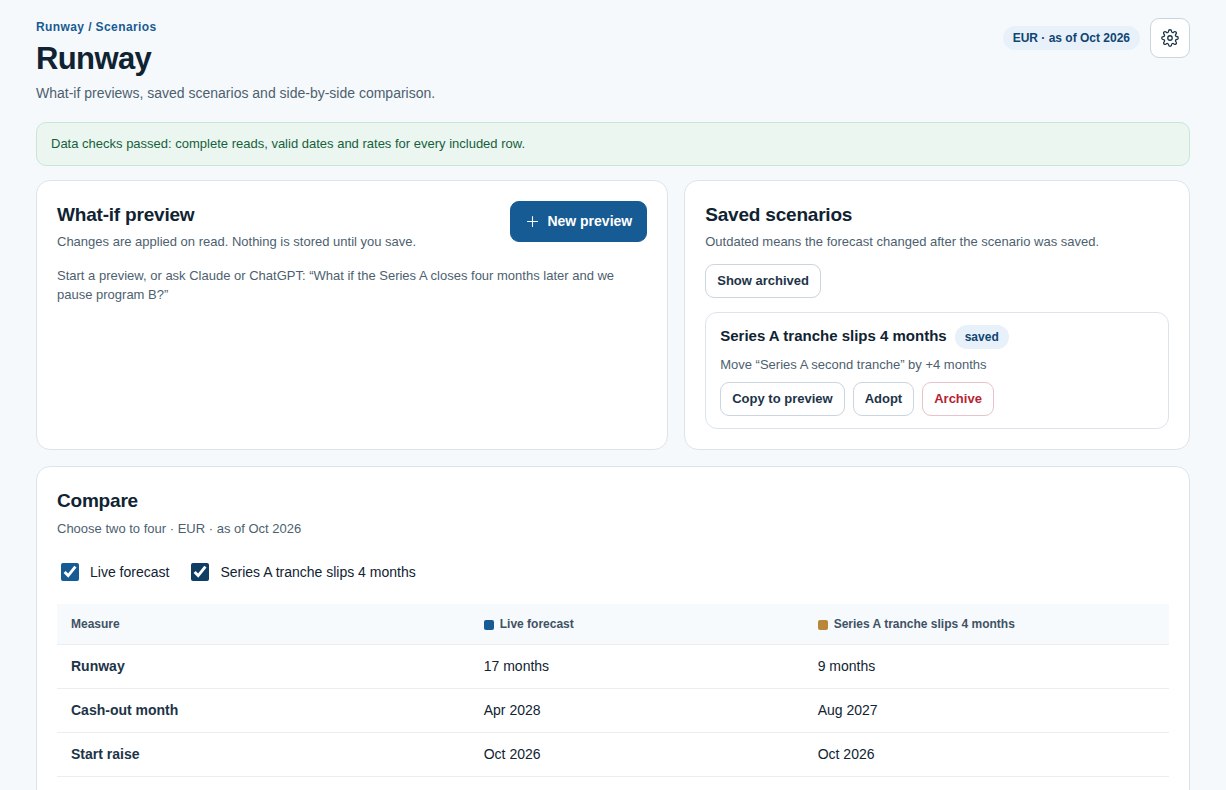
Assume the project lead and finance team identify a feasible reduction in Program B’s external work to €30,000 per month across the full example period. In Scenarios, preview Scale program spend for Program B at −50%.
This operation scales spend lines assigned to the selected program. It does not reduce People positions, unassigned overhead or Program A’s spend. The candidate therefore costs €90,000 + €30,000 + €70,000 = €190,000 per month. Previewing stores no change to the source plan.
| Month | Baseline: €220k/month | Candidate: €190k/month |
|---|---|---|
| March | 1,740 | 1,830 |
| June | 1,080 | 1,260 |
| September | 420 | 690 |
| October | 200 | 500 |
| November | −20 | 310 |
| December | −240 | 120 |
The baseline first becomes negative in November. The candidate remains positive through December, with €360,000 more cash: €30,000 × 12. That is a within-period result, not a claimed cash-out date beyond the modeled commitments.
Now consider a misleading allocation: assigning half the €70,000 shared line to B would make B appear to cost €95,000. Scaling that entire amount by −50% would imply €570,000 annual savings. It would overstate the intended saving by €210,000 because it also removes half of B’s allocated shared cost—even though the shared team and facilities remain.
Review the work, the contracts and the company total
With Runway connected in ChatGPT or Claude, ask: “Compare the baseline with a 50% reduction in Program B’s spend lines. Keep Program A, people and shared overhead unchanged. List the affected records and report the app’s monthly cash results before proposing any save or adoption.” Check the available actions and permissions; let Runway calculate the forecast.
You can customize the app’s review fields or presentation to distinguish shared, program-specific and potentially avoidable payments. Such labels support a review; they do not prove that a vendor payment can be cancelled.
Where you use other TrialAgents apps, connect their data explicitly. Runway 2.2 documents reviewed use of linked milestones, commitments and obligations. Linked sources remain owned by their source app, and importing or updating a plan line requires review. Existing saved versions are not automatically upgraded.
The project lead must validate the revised scope and milestone consequences. Finance must confirm payment changes, residual commitments and any transition costs. A 50% spend reduction does not establish that the same science will be delivered, or that contract obligations disappear. For timing changes rather than savings, use the clinical-delay planning example.
Save or adopt only the reviewed candidate. Reconcile the company total again afterward, keeping shared costs counted once. Monthly runway supports this portfolio decision; exact payment-day liquidity and scientific prioritization require their own review.
Start with Runway
Compare program choices against one transparent company cash forecast.
Start with Runway →