
Grant-funded biotech · Series D
Financial planning for grant-funded biotechs: separate award, claim and cash
A grant ceiling is not a bank receipt. Keep the full project payments in your cash plan, then add the receipts your finance team can substantiate.
First-party guidance with an independently calculated fictional example, informed by Runway 2.2 documentation. Screenshots are genuine 2.1 browser demos with separate data. No end-to-end assistant test or grant-compliance assessment is claimed.
Choose tools for three different jobs
For a small biotech funding an assay-development project, our recommendation is to keep evidence, claims and company cash planning connected but distinct. TrialAgents Runway handles the monthly forecast. It does not decide which costs a funder will accept or submit a compliant claim for you.
| Job | Suitable place | Review owner |
|---|---|---|
| Prove expenditure | Accounting records, invoices, payroll and time records | Finance and project team |
| Prepare the claim | A controlled claim workbook or grant-management system, plus the funder’s submission process | Grant owner |
| Plan company cash | Runway: gross payments, expected receipts and company overhead | Finance lead |
This separation matters for reimbursement funding. For example, Innovate UK’s published terms, section 9, describe eligible-cost reimbursement, generally quarterly claims in arrears, evidence requirements and a retained final amount. Your award’s terms determine the actual rules; that example is not a universal grant schedule.
A claim tracker can establish the amount and expected receipt date. Runway then shows whether the whole company can support the project alongside its other commitments. For a broader software shortlist, see our cash runway software comparison.
Enter the whole payment, not the subsidized share
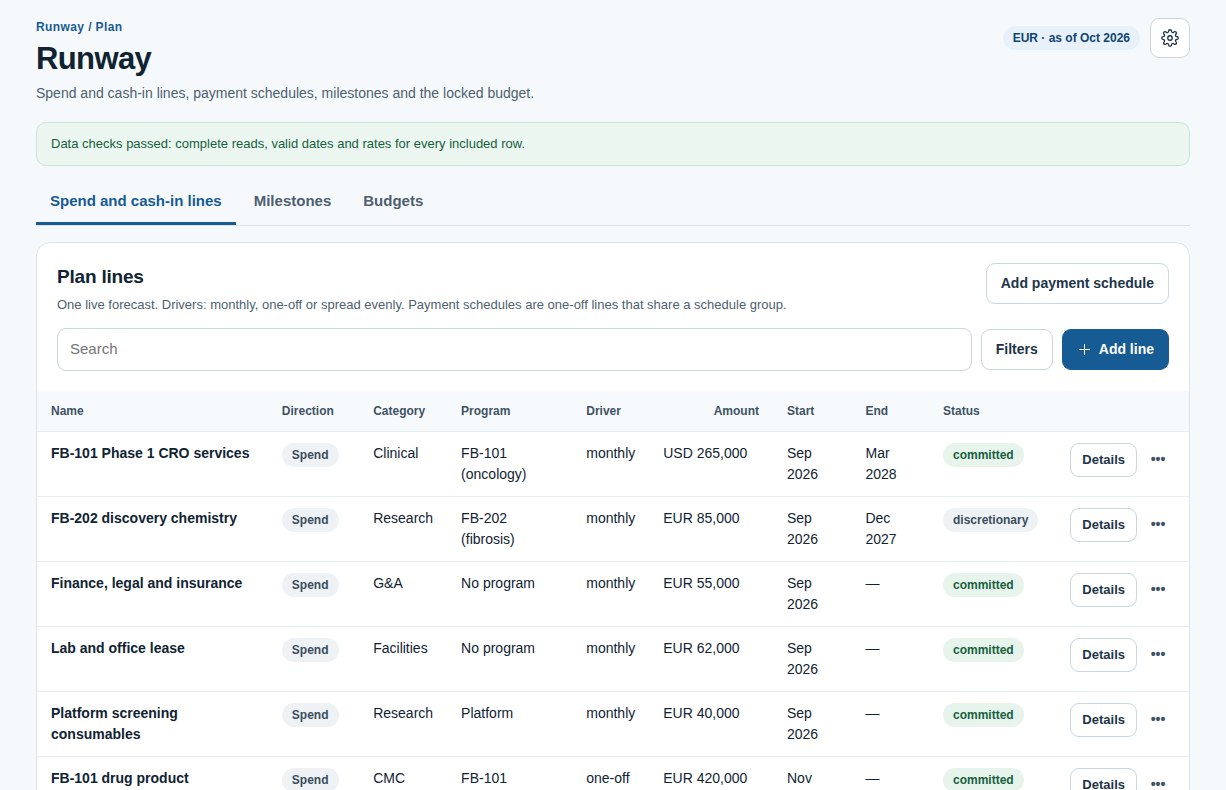
Use this fictional EUR example, not an Innovate UK award simulation. Settings starts with €900,000 cash at 31 December 2026. Plan contains €50,000 monthly company overhead for January–December 2027 and €80,000 monthly project payments for January–June. Both amounts include their people costs; do not enter those same salaries again in People.
Assume the grant owner has reviewed €60,000 of each month’s project spend as eligible under this fictional agreement, with a 50% reimbursement rate and a €240,000 award ceiling. The six-month calculation is €60,000 × 6 × 50% = €180,000. The ceiling does not turn that into a €240,000 receipt. The company bears €300,000 of the €480,000 project payments after reimbursement.
For the worked cash case, assume two €90,000 grant receipts, in April and July. Create separate one-off cash-in lines with type Grant and those receipt months. Keep the €80,000 project spend gross. Reducing it to €50,000 and also adding grant receipts would count the benefit twice.
Receipt timing and amounts are planning assumptions. Record the status the finance owner can support: contingent funding is excluded from the base calculation and included only explicitly; committed or received funding enters the base. An award letter alone does not let software determine whether a particular claim is unconditional.
The example has no retention, tax, FX, financing, other receipts or reserve. Real agreements may require each of these adjustments. Calculate eligibility, rate, caps and retention outside standard Runway, then bring the reviewed cash schedule into Plan.
Reconcile project economics to bank timing
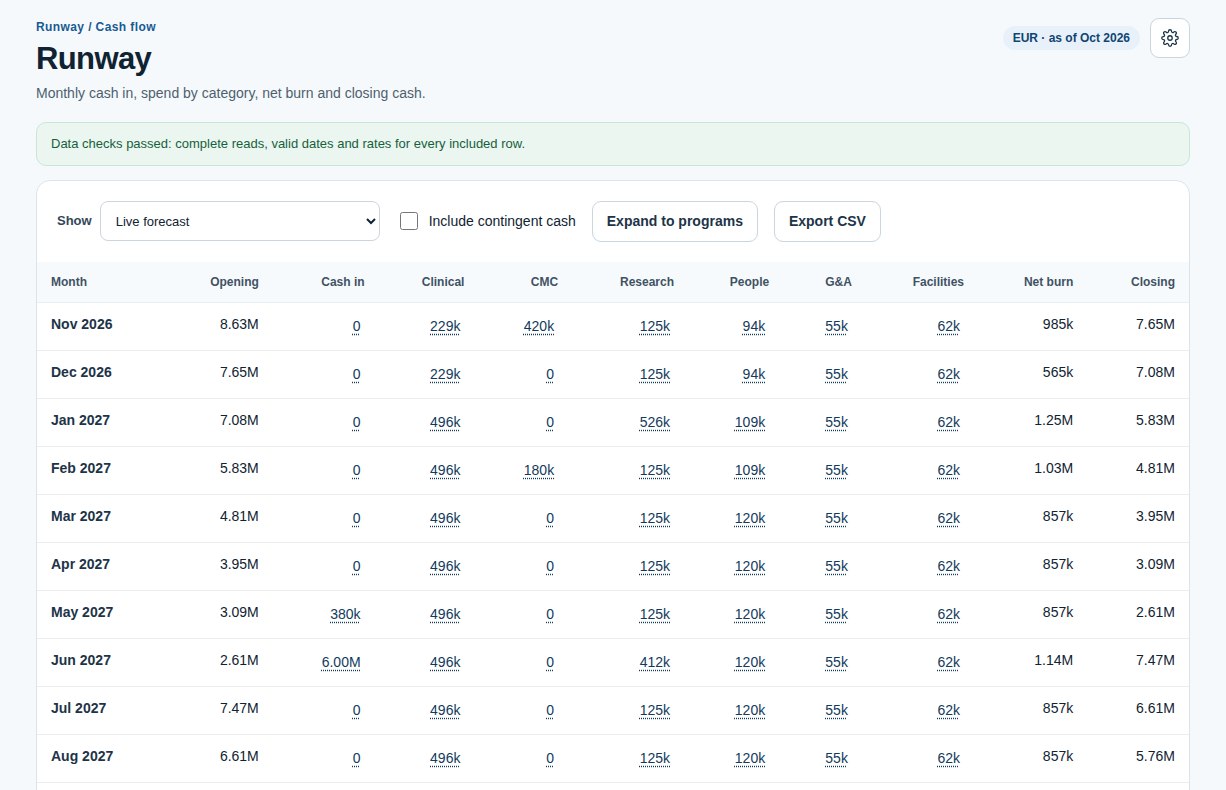
Open Cash flow and inspect the full payments and the two receipts, explicitly including them for this case. Compare that with the tempting shortcut of deducting €30,000 reimbursement from project spend every month. The shortcut gets the eventual project contribution right but invents earlier cash availability.
| Month | Full payments; April/July receipts | Incorrect monthly netting |
|---|---|---|
| March | 510 | 600 |
| April | 470 | 500 |
| June | 210 | 300 |
| July | 250 | 250 |
| December | 0 | 0 |
June cash is €900,000 − six months × (€50,000 + €80,000) + €90,000 = €210,000. Monthly netting overstates it by €90,000. July adds the second receipt and subtracts €50,000 overhead, bringing cash to €250,000.
In Cash flow, drill into the receipt and spend cells to check the source lines. Treat the July receipt as financing in Runway’s burn calculation: grants do not reduce its operating net burn. Cash balance, project contribution and operating burn answer different questions.
December reaches zero under these assumptions; that is not a claim about a later cash-out month. The model is monthly and does not establish whether cash is available before a particular supplier payment within a month.
Keep the evidence behind each receipt
With Runway connected in ChatGPT or Claude, ask: “Review the grant receipt lines against this finance-approved claim schedule. Flag amounts entered from the award ceiling, missing receipt months and any reimbursement also deducted from spend. Show proposed corrections before saving.” Let the app calculate the forecast; the assistant should not certify eligibility or replace the grant owner’s review.
You can customize review fields and presentation around your process. A claim reference or evidence link can be added through a reviewed customization; it is not a built-in grant-compliance engine.
Connect another app’s data explicitly where useful, with the appropriate access. Standard Runway does not automatically sync your accounting system or funder portal. Keep the evidence record authoritative and review changes before they reach the cash plan.
At each review, the project lead confirms the activity and payments; the grant owner checks the claim assumptions; finance reconciles receipt dates, cash status and bank balances. If a claim is reduced or delayed, update that cash assumption without silently changing the underlying project costs. The funding-timing example shows how to inspect a later receipt separately.
Start with Runway
Keep grant receipts and project payments visible in one company cash forecast.
Start with Runway →