
Funding-round planning · Series D
Plan biotech runway around a funding round: find the gap before the cash arrives
Keep the next round separate from the cash you can already plan on. Then move its receipt date and inspect every month before it lands.
A first-party worked example using documented Runway workflows. Figures are fictional and independently calculated; screenshots show separate demo data. This is not an end-to-end ChatGPT or Claude test.
A target closing date is an assumption
A biotech can have a credible development plan and still run out of cash before its next round arrives. Our starting point in TrialAgents Runway is to show the plan without that prospective funding, then compare an explicitly contingent case.
The U.S. Small Business Administration’s funding guidance describes investor review, due diligence and negotiation of terms before investment. It does not establish how long your round will take. Keep the forecast receipt month separate from your evidence about funding certainty.
Runway cash-in records distinguish committed, received and contingent funding. The base calculation includes committed and received records; contingent receipts enter only when you include them. That is an app planning status, not a legal judgment about an investor’s obligation. Have the responsible finance owner review the classification.
How long does existing funding support the plan? What changes if the proposed round arrives in the assumed month?
Put the payment and the round on separate rows
Consider a fictional biotech paying for an evidence package in June. Set EUR as the reporting currency in Settings, with €1.2 million opening cash dated 31 December 2026. Use January–December 2027 as the comparison period.
| Runway input | Assumption |
|---|---|
| Plan: recurring company spend | €150,000 monthly, January–December; includes all people costs |
| Plan: evidence-package payment | €300,000 one-off spend in June |
| Plan: prospective equity receipt | €600,000 cash in, June, contingent |
Enter the payment as a spend item. A milestone date alone is not a cash payment. Keep its June timing unchanged while testing a later financing receipt, so the comparison isolates funding timing rather than quietly postponing the work too.
Do not add the same salaries again in People: they are already included in this simplified monthly spend. The €600,000 is assumed available cash; the example excludes transaction fees, taxes, FX, other receipts and any bridge financing. Add those explicitly when they apply to your actual plan.
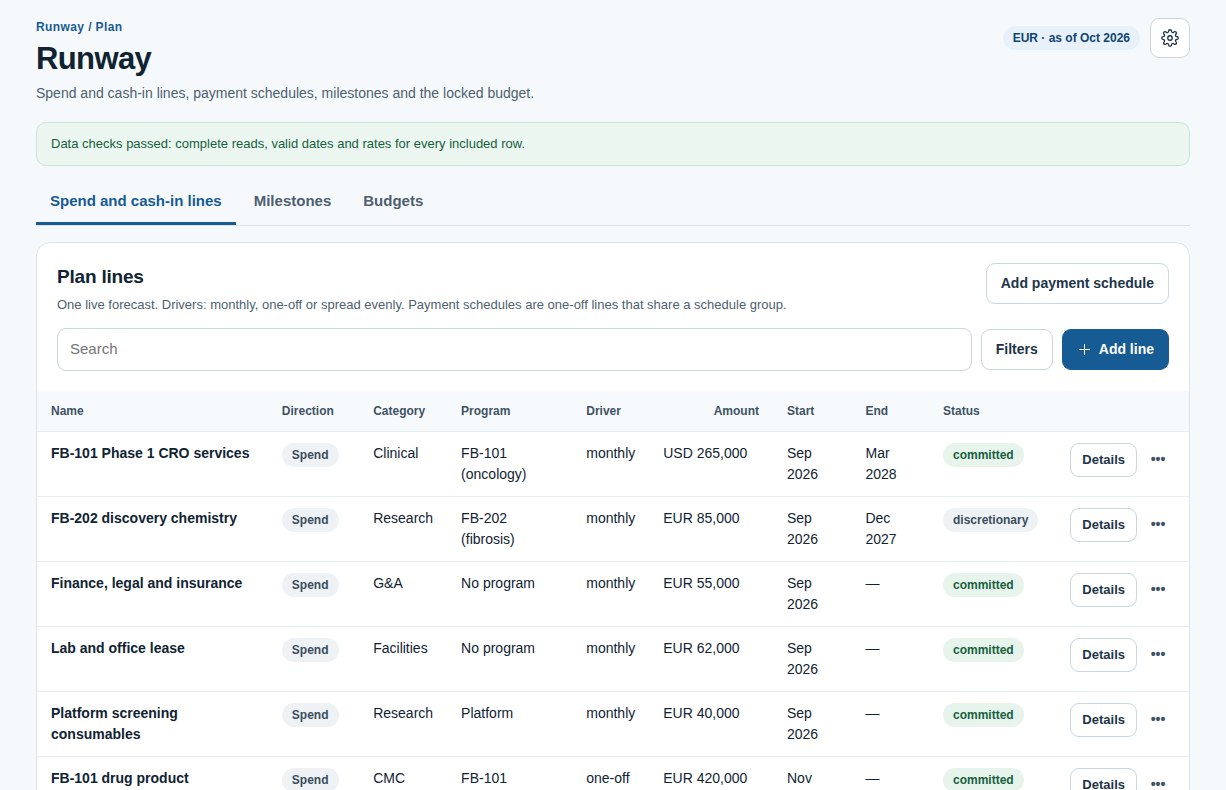
September cash cannot pay July’s bills
First inspect Cash flow with contingent funding excluded. Then include the proposed €600,000 June receipt. In Scenarios, preview Move cash in for that receipt by three months, to September, keeping the same contingent-inclusion setting and all spend unchanged.
| Month | No new funding | €600k in June | €600k in September |
|---|---|---|---|
| May | 450 | 450 | 450 |
| June | 0 | 600 | 0 |
| July | −150 | 450 | −150 |
| August | −300 | 300 | −300 |
| September | −450 | 150 | 150 |
| October | −600 | 0 | 0 |
| November | −750 | −150 | −150 |
Each month is prior closing cash plus receipts minus payments. June without funding is €450,000 − €150,000 − €300,000 = zero. July is the first negative month; Runway’s cash-out convention is first negative, not first zero.
The June receipt moves the first negative month to November. The September receipt does not: July and August are already negative. Although both funded cases reach €150,000 in September, the later case needs a separate, feasible action before the shortfall. The table does not assume an overdraft or manufacture a bridge.
The €300,000 August deficit is only the example’s month-end gap before September. It is not a recommended financing amount: it excludes a reserve, fees and payment order within each month. A zero June balance also deserves attention before July. Standard Runway is a monthly model; use a separate dated cash schedule to examine intramonth liquidity.
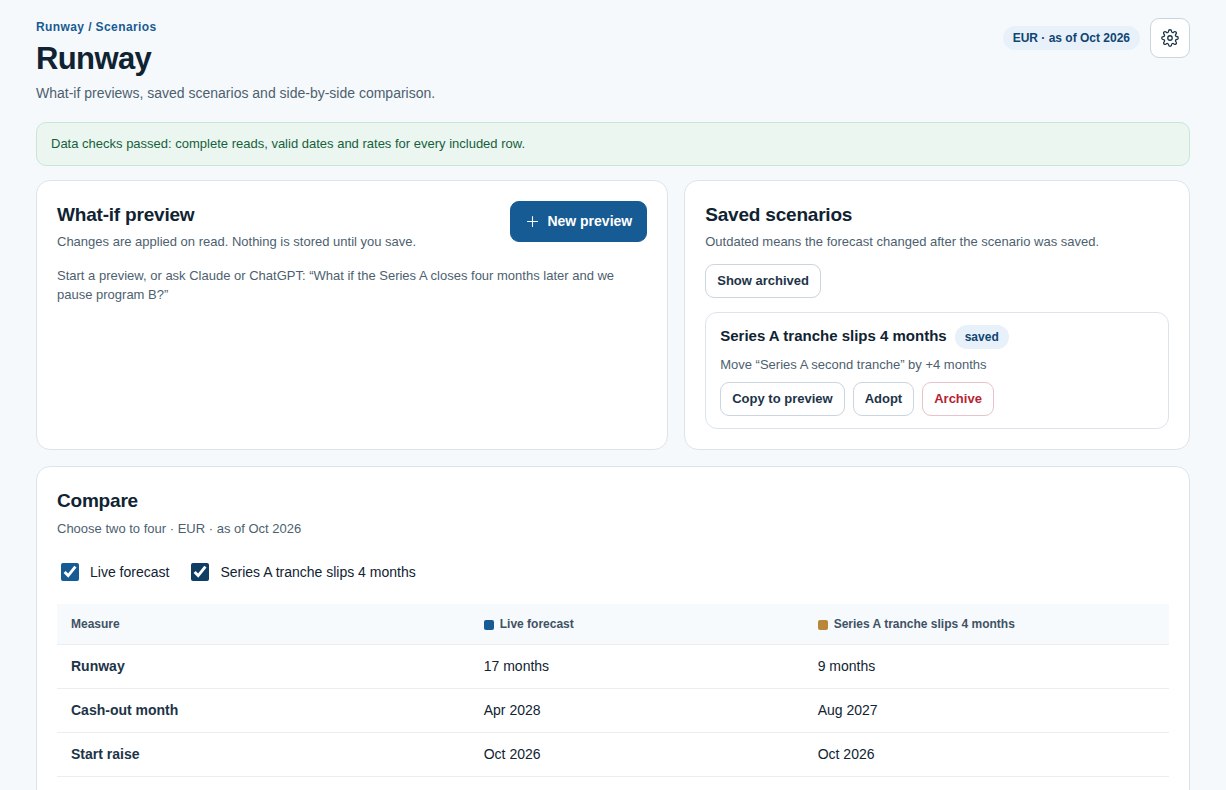
Make the gap the review decision
In a connected ChatGPT or Claude session, ask: “Compare the plan excluding contingent funding with the June and September receipt cases. Identify the first negative month and explain the cash-in setting. Do not change source records or assume bridge funding.” Review the returned scope and inputs; let Runway calculate the outputs.
You can ask to customize the app’s review fields or presentation around your funding process. Treat that as an explicit customization, not a claim that standard Runway includes an investor CRM, cap table or automatic fundraising prediction.
If another app holds milestone evidence, connect the relevant data explicitly with appropriate access. Installing Runway does not automatically synchronize bank, accounting or investor records. Keep an owner responsible for confirming the receipt amount, conditions and expected month.
A scenario preview stores nothing. Saving a scenario uses two reviews, first its parent and then its child records. Adoption is a separate review of source changes; it does not make contingent funding certain. Keep the no-new-funding case available when sharing the decision.
Before approving additional spend, record what must happen before July in this example: a verified earlier receipt, an agreed change to payments, or another reviewed plan. Recalculate that action explicitly rather than treating September’s positive balance as proof that the intervening months are funded.
Start with Runway
Keep funding assumptions visible and compare the cash gap before your next round.
Start with Runway →